As leaders, we talk a great deal about performance, energy, and resilience. Yet, when it comes to the physical realities that shape a woman’s ability to sustain those qualities across decades, many of us are left without the information or support we need.
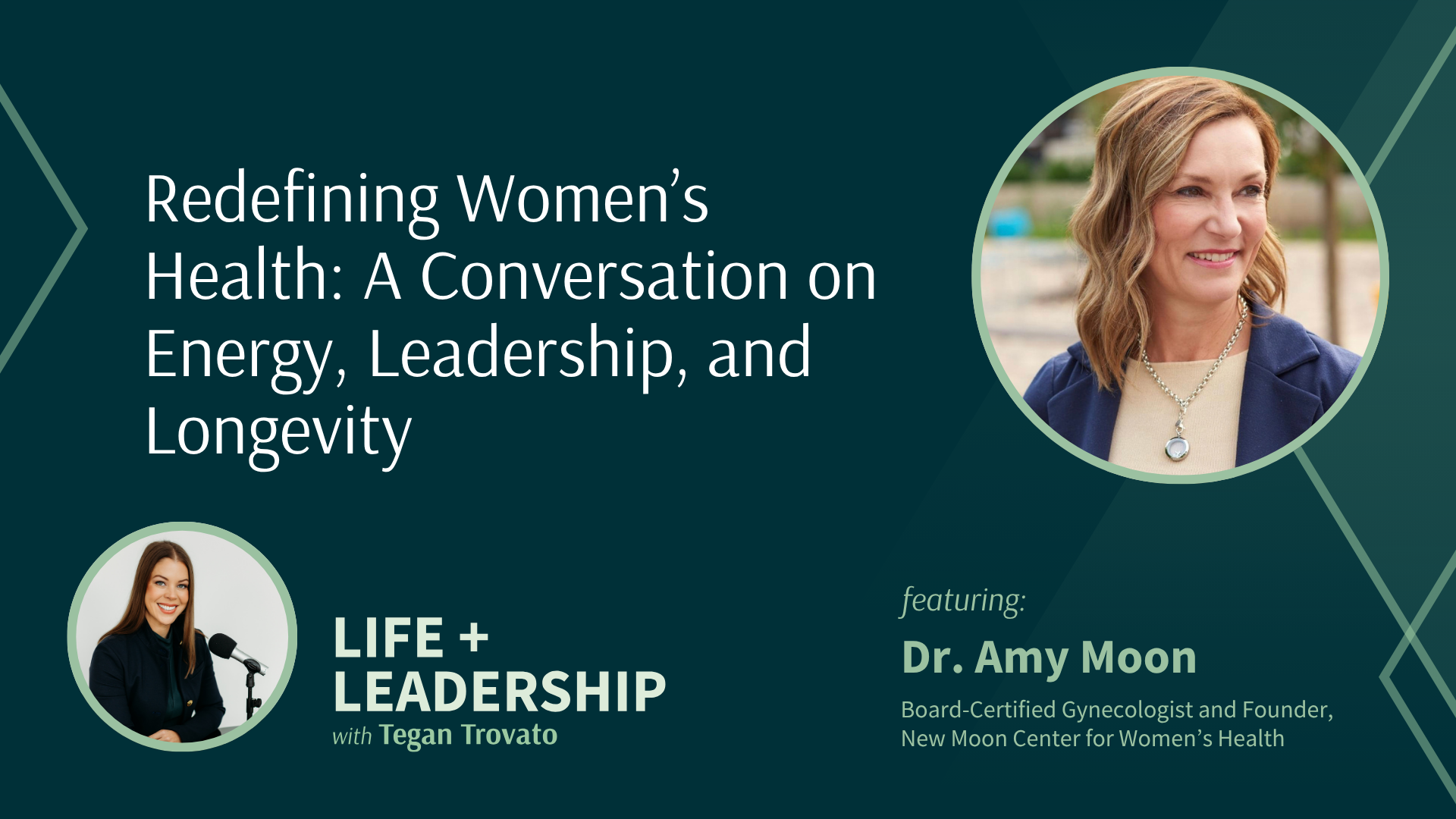
In this episode of Life + Leadership, I speak with Dr. Amy Moon, a board-certified gynecologist and founder of the New Moon Center, who has dedicated more than twenty-five years to helping women thrive through every stage of life. Dr. Moon’s work focuses on menopause management, hormonal health, and minimally invasive gynecologic surgery. Her approach is deeply compassionate and rooted in evidence-based care, helping women understand and respond to the changes that occur during midlife and beyond.
Together, we explore how women can reclaim control of their well-being, make informed medical decisions, and approach longevity as both a personal and professional advantage.
Closing the Knowledge Gap in Women’s Health
Dr. Moon has spent her career addressing one of the most persistent issues in modern medicine: the lack of understanding surrounding women’s hormonal transitions. She points out that most women enter perimenopause and menopause with limited guidance and, as a result, normalize discomfort that could be treated.
“We have been conditioned to tolerate discomfort,” she told me, “but suffering is not a requirement of womanhood.”
Her words remind me that so many female leaders I coach are silently navigating physical symptoms while carrying immense professional responsibility. Dr. Moon’s message is that care and ambition can coexist. By seeking the right support and being proactive about our health, we can sustain our energy and clarity well into later life.
Understanding Hormones, Energy, and Stress
Our conversation turned to how hormonal shifts affect far more than physical comfort. These changes influence our focus, decision-making, and emotional regulation. Dr. Moon explained how chronic stress accelerates hormonal imbalance, creating a cycle that erodes energy and resilience.
She encourages women to interpret their bodies as a source of data. When we listen to that data and make changes—through nutrition, movement, and appropriate medical care—we create stability that improves every aspect of our leadership.
As someone who coaches senior leaders, I often see how the tendency to “push through” stress leads to depletion. Dr. Moon reframed this habit as both a health and leadership risk. “The body always keeps the score,” she shared. “Ignoring what it is telling you means losing access to your greatest strengths.”
Rethinking Longevity as Leadership Strategy
Dr. Moon defines longevity not simply as extending life but as protecting vitality. At the New Moon Center, she combines medical expertise with holistic care to help women remain strong, focused, and joyful.
She believes that thriving through menopause and beyond is possible when women are empowered with knowledge. Preventive care and early conversations about hormonal health allow women to age with confidence rather than uncertainty.
“It is never too early to be curious about your hormonal health,” she said. “When you understand what your body needs, you make better choices that affect every dimension of your life.”
Her insight reinforces what I often tell leaders: investing in well-being is not indulgent, it is essential to sustaining influence and clarity over time.
Advocating for Women’s Health at Work
Our discussion also touched on the role organizations play in supporting women’s longevity and leadership. When companies normalize discussions about women’s health and provide education and flexibility, they retain talent and strengthen performance.
Dr. Moon and I both believe advocacy begins with conversation. For women in executive roles, that means speaking openly about health, setting boundaries that protect energy, and encouraging others to do the same. For employers, it means designing cultures that view well-being as a strategic advantage.
“You deserve to be heard,” Dr. Moon told me, “and you deserve to feel well.” Those words encapsulate the heart of her message. Women’s health is not a private burden to carry alone; it is a leadership issue that affects entire organizations.
People in This Episode
Dr. Amy Moon
Board-Certified Gynecologist and Founder, New Moon Center for Women’s Health
Tegan Trovato
Host, Life + Leadership Podcast and CEO of Bright Arrow Coaching
Listen + Learn
If you have ever wondered how your health influences your leadership, this conversation will give you clarity, encouragement, and a roadmap for taking action. Listen to learn how to:
- Reframe menopause and midlife as seasons of renewal
- Strengthen energy and focus through evidence-based care
- Build sustainable practices for stress resilience
- Advocate for women’s health in leadership and organizational life
You can listen to this episode on Apple Podcasts, Spotify, or wherever you get your podcasts.
Resources
North American Menopause Society (NAMS) — https://menopause.org – directory of certified practitioners can be found here
The Menopause Manifesto by Dr. Jen Gunter –https://drjengunter.com/the-menopause-manifesto/
Vagina Bible by Dr. Jen Gunter – https://drjengunter.com/vagina-bible/
The Gen Death Podcast by Dr. Jen Gunter – https://drjengunter.com/podcast/
Estrogen Matters by Dr. Avrum Bluming and Carol Tavris – https://estrogenmatters.com/
The New Menopause by Dr. Mary Claire Haver – On Amazon
App ‘’Rosy’’ – for sexual health and libido issues – Download here
OMG Yes – sexual wellness and female arousal content – OMG Yes Website
Transcript
Tegan Trovato
Today’s episode is one I’ve been looking forward to for a long time. I’m joined by Dr. Amy Moon, board certified gynecologist and founder of the new Moon Center for Women’s Health, and one of the most trusted experts on menopause management and women’s longevity. At Bright Arrow, we coach countless women executives who are navigating demanding careers while also managing the realities of hormonal and metabolic changes in their 40s, 50s, and beyond. Senior executive women have a unique set of healthcare needs, and in my opinion, we are not doing enough in the world to acknowledge those needs or to provide support and resources. While these needs often surface in the executive coaching sessions, our role as coaches is to connect women with the right experts who can help them thrive.
Dr. Moon is exactly that kind of expert. In this episode, we talk about what every woman needs to know about hormone health, stress, and energy, plus the myths that have long kept women from getting the care they deserve. This one’s a masterclass in understanding your body and advocating for your well-being.
Creating a More Complete Model of Women’s Healthcare
Dr. Moon, welcome to the podcast. I have been so looking forward to this conversation, and I know I’ve shared with you why.
I’m going to share a little with listeners before I start pilfering you with questions. But for listeners, one of the reasons I wanted to have Dr. Moon join us is she’s so revered in her profession. She has so much wisdom to share, and part of the reason I wanted to bring her wisdom forward is that we coach a lot of women executives at Bright Arrow, and their health is so unique in these decades of 40s, 50s, 60s beyond, and it ends up coming up in our coaching agendas at some point.
Our coaches are not health experts, but it is our job to be able to bring forward meaningful resources, make great introductions to people like Dr. Moon as they need it. I also am a woman in my 40s and have had personal experience with hormone supplementation, the need for that. I’m a mom, so I’ve had the postpartum experience and the unique needs of that.
So I have lived as a busy executive the reality of women’s unique health needs and this need for energy and specialized care in these decades of our lives, because the business is demanding so much from us, as are our families. So Dr. Moon is going to share much more than you can guess at the moment. Please have pens and paper ready.
Any resources we cite today, we’ll be sure to have in the show notes for you. So Dr. Moon, to dive into your world, let’s start first by telling listeners about New Moon Center for Women’s Health here in Indianapolis, why you created that practice, first of all, and then some about the services, because I think people understanding the services that you offer gives a holistic view already of women’s health.
Amy Moon
I came from a large group and I came from being employed in a hospital system. And I never felt like we could finish the entire loop when we took care of the patients that we did. And I wanted to create a space where we could fill in those gaps in care or make things easier for women, because we are so busy.
It’s difficult for people to make multiple appointments on multiple times, multiple days, and then still feel like they would have to kind of come back for more and never quite get everything finished off. So when I built the clinic, my goal was to combine the gynecology services that I provided with primary care services. A lot of people go and get done elsewhere and then offer as much testing on site as we could to make it easy for women to access things like their mammograms and their blood work.
Understanding Hormones, Stress, and Energy
We can do ultrasounds on site. And then it kind of evolved into some other service lines related to our medical spa where we can offer more aesthetic services. And even some of those services are still medical because we use some of those machines for things like incontinence or pain and things like that.
So the concept was more inclusive and easier and just fill in the gaps. And a prime example might be a patient that I’d seen for years who might come in each year and their blood pressures are elevated. And I’d say, every time you come in, we’re noticing hypertension and I see you don’t have a primary care provider, but we really should get you in with one because I think you might need medicine for it.
And they’d say, oh, you tell me that every year, Dr. Moon. I’m going to do that this year. But then they wouldn’t.
And so I just didn’t feel like I was really making sure to take care of some of the big things for women. They’d come in for the other things. And so once I had primary care on site and I could easily get them in with someone so we could begin to manage those other things, it just started to feel more full circle to me.
And that made me feel like I was making a bigger impact on women’s long-term health, not only being like the pap smear person.
Tegan Trovato
Right. Beautiful. And then when you meet with women, how are you helping them come to understand that they have unique needs?
I mean, I think as I talk with a lot of women, even in my social circle, not just our clients, I will often hear them say things that I’m like, did you know that’s hormone-related probably? Or have you thought about that being related to your postpartum experience? There’s so much we don’t know as women about ourselves, unfortunately, still.
Hormone Replacement Therapy and Debunking Myths
So I’m curious, when a patient comes to you, what are some of the ways you help to illuminate those unique needs for them?
Amy Moon
Well, one of the processes that we’ve included that has been helpful is just pre-registration asking kind of like a series of questions that might seem like, why is she asking me all this? And, you know, I think sometimes people want to like rush right through it, but I kind of want to know what your problems are so I can go through and say which one of those things could be hormonal related or not hormonally related. So we might ask questions about headaches or being dizzy.
We might ask about chest pain or shortness of breath or palpitations. And these are not things that women will oftentimes bring up in a verbal conversation because maybe the laundry list is too long or they’re downplaying their own symptoms and they don’t think it’s that important. So the first step is just having the opportunity to ask the right questions so we can address them.
And then I can go over with them during their visit which things are attributable to hormones or if we need to rule out other causes. And I think they just appreciate that attention to detail where we are going to pay attention to the whole thing. I’m not just going to ask them two questions, but I’m going to give them an opportunity to be more inclusive of the symptoms they might be experiencing so that we can talk about it.
Tegan Trovato
And as you reflect on your patients who are in, you know, the 40s plus range, as I would expect most of our listeners are as senior executives, senior leaders, what do you notice as some of the most common things they’re either presenting with or some of the more common conversations you tend to have with women in this age range?
Amy Moon
Well, a lot of women are struggling with maintaining their weight. They’re noticing big shifts in their metabolism. And a lot of times they’ll say, well, maybe I’m just not trying hard enough.
Maybe I’m just not cutting the carbs like I should, or maybe I’m just not going to the gym enough. But then they’ll tell me I’m doing the exact thing I used to do and I’m just gaining weight. And so we have to have a conversation about how your metabolism changes as your hormones shift.
That’s a really good one. I hear a lot of professionals say, I just don’t feel like I’m on my game. It’s like hard for me to remember things.
It’s hard for me to stay focused and pay attention. It’s like I’ve developed ADD or something. Maybe I need to go see a psychiatrist and get tested for ADD.
And so we can talk about how hormones can affect just even your simple concentration. But I do think a lot of sleep disturbance starts happening and people see major differences in their energy levels. And I used to be able to go all day and I had energy all day.
But now after lunch, I feel like I have to take a nap and I just can’t stay awake. I’m so tired. And it really impacts your work if you can’t focus and you don’t have any energy or you feel down about your self-image because your clothes aren’t fitting the way they used to.
Those are the ones that really sneak in that people don’t always realize it’s a hormone change.
Tegan Trovato
We’ll go back to the metabolism piece. What is the advice you give patients when you suspect it’s a metabolism decline slump? I don’t know what word you might use for that change.
Amy Moon
Well, certainly we’re going to discuss outside of hormone replacement therapy, what other strategies can work for women when your metabolism changes. And really what’s happening in the body as you’re losing some of your estrogen sources is your body is starting to have to make more insulin in order to maintain a healthy blood glucose. So if you were to go in and get a glucose test done or an A1C done, they probably are going to look about the same because your body’s compensating for that change by creating a higher insulin level.
And it may not even be detectable, but it’s higher than what you used to make. And since insulin is your fat-storing hormone, it’s telling your body to take sugars and store them as fats, and they’re going to store them as fats on the internal organs of your abdomen called your viscera, which is why so many women say, it’s all in my waist. I’m feeling it all in my waist.
I’m feeling all bloated there. All my weight gain’s going there. I’ve never gained weight in my waist before.
So from a dietary standpoint, this is when we start to talk about macros and we look at things like eating more protein or eating more fiber because those are going to kind of regulate your blood sugars, looking at concentrated sources of carbohydrates and trying to make them more complex or reducing them. And then I also like to reiterate how exercise can eat up your glucose and can speed up your metabolism just by even walking 10 minutes a day can make a big difference in that kind of insulin and glucose ratio. Some of our patients who are becoming pre-diabetic, we might be having conversations about medications like metformin.
And then if we’re seeing a lot of signs and symptoms of the estrogen deficiency, then we might have a conversation about what it looks like to start adding in those hormones for our metabolism.
Tegan Trovato
All right, let’s go to HRT, hormone replacement therapy, also known as HRT. I mean, I am well-read on the whole study that was recently debunked about how there was a correlation of hormone replacement therapy and cancer incidents in women. You will be far better qualified than myself to speak to that.
So could you educate listeners on, at a high level, laywoman’s terms? What was that study about? What have we debunked since?
And how has that brought us into a new chapter of care for women at this chapter of their lives?
Amy Moon
Yeah, so the Women’s Health Initiative was published in 2001, which was the same year I graduated from my residency training program. And it sparked a lot of conversation. Around that time, they were having the annual WFYI Women’s Conference in downtown Indianapolis, and I got contacted to be a speaker.
And I ended up speaking on that study to a room of 1,000 women. And I mean, I had just graduated, and we were just starting to understand the information in the study. But even then, when I looked at it at the time, there were flaws.
There were a lot of flaws in the design of the study. It was well-intended, by all means. It was a large trial, very large number of women involved.
Most of them were nurses, but the average age of the study participant was 63 years old, which is not a target range to be starting hormone replacement therapy. And they only studied two medications at the time. They only looked at Premarin and Prempro.
So if you’re not familiar with those, they’re older hormones. The Premarin is a conjugated estrogen from the horse urine, and then the Prempro is the same thing with a medroxyprogesterone as your progestin. And the study was halted because in the Prempro group, after five years, there was an increased risk of breast cancer at a rate of one per 1,000 women.
So it wasn’t like a huge amount, but it was enough for them to halt the study. And that’s when it hit the news. Hormones cause breast cancer.
Well, they didn’t talk about the estrogen-only arm, which would have been a really important thing to discuss, and how the women in that arm actually had a reduced risk of breast cancer when they were on an estrogen-only. So many menopause experts would blame the progestin, the synthetic progestin, as the potential thing that was causing the extra breast cancer. The other thing about that study that was very interesting is in the placebo group, those women had less, I want to say, poorer health in the long term.
So the women in the placebo group had a higher overall mortality. They had a higher incidence of morbidity from heart attack, stroke, osteoporosis, falling down, breaking their hips. It was just kind of astounding that the placebo group had poor health and that both of the groups where women were on hormones had overall better health.
And it’s kind of like the breast cancer was the only important thing, except for they did not have extra deaths due to cancer in the PREMPRO group. Actually, the death rate from breast cancer was higher in the placebo group. It’s like the whole thing got backwards and just threw us back 20-plus years on allowing women to feel safe about taking hormone therapy.
And since then, all of the studies have been done on different hormones, different combinations, all over the world. And the studies just do not represent that kind of fear factor that all hormone therapy is going to cause breast cancer. So I think that’s really been a turning point, that and just the fact that hormone therapy does allow women generally to live longer and healthier.
And I think those got lost, got lost in the message.
Tegan Trovato
Yeah. And so today, my experience has been, it is hard to find practitioners, GPs, for certain, it can be difficult to find GPs who have really great hormone supplementation acumen. And even in the GYN world, I think it can be hard.
So how might listeners be able to discern if someone’s got the most up-to-date information and training on hormone replacement therapy to help support their evaluation and supplementation?
Amy Moon
Well, there is a good resource. It’s going to be the Menopause Society. And they offer a certification to practitioners, both MDs, nurse practitioners, and PAs.
You can go to that website, you can put in your zip code, and it’ll pop a list of people in your area who have a menopause certification. And I think hopefully more and more people get that certification so we can continue to have access for women. But there are primary care doctors on there, gynecologists on there.
If you want to find the best resource, that’s the place to go. It’s through the Menopause Society.
Tegan Trovato
And please correct anything I might get wrong here. My understanding is that because of that study, FDA, at the time, put in warning labels on hormone supplementations that were quite scary, and then maybe also didn’t continue to evolve its guidelines on how to treat women. Do I have that right?
Amy Moon
Yeah, I mean, the FDA definitely has some very strict labeling on classes of drugs that are probably scaring women off from utilizing them, and it may not relate to that actual product. A really classic example has to do with vaginal estrogen therapy. So a vaginal estrogen has never been shown to cause a breast cancer, but Prempro did, right?
So they’ve decided that anything in the estrogen family, regardless of the route of administration, is going to have a label on it that scares people that they could get a breast cancer. They took information on heart attack and stroke. So in the Women’s Health Initiative, if you were over the age of 63 when you initiated your hormone replacement therapy, that actually increased your risk of a heart attack and stroke.
But it didn’t in the younger population, but they broadly placed it in all estrogen products. This could cause a heart attack and a stroke. We know that oral estrogens can increase your risk of a blood clot in your legs or lungs, and vaginal don’t.
But because of that oral correlation, the FDA has labeled all estrogens as a group, saying it could cause you to have a blood clot in your legs or lungs. And that list goes on and on when you look at the black box warnings. And there’s a lot of advocacy right now within the menopause experts to try to get that changed, but we haven’t really made good progress on that yet.
So I have to have a lot of conversations with women about the labeling and explain to them why it is the way that it is and why I’m so comfortable prescribing it and that that isn’t a concern for them. And so it does take extra time and education.
Tegan Trovato
Well, educate us more on each of the like main three hormones. I think there’s main three that you would prescribe for women. I think I hear most often that women are surprised we’re being prescribed testosterone, for example.
So help us myth bust. What are you hearing? What are you most often having to educate about how the hormones interplay, why you may give one and not another, why you may give all three, and what each of them may do for a woman who needs HRT?
Amy Moon
Well, you are correct. The ovaries are responsible for making three separate hormones in the body. They make your estrogens and they do make your progesterones and then they’re responsible for making half of your male hormone, your testosterone, because the other half does come from your adrenal gland and it gets converted through the production of that DHEA that androgen glands make.
In a premenopausal woman, we see estrogen levels go really high and really low and that’s how you create your cycle. And so I often find that non-menopause experts will check an estrogen level at the wrong date of the cycle and then will inappropriately tell a patient it is too high or too low because they don’t understand how it varies. I see the same thing happen with that hormone progesterone because when you’re in your ovulation cycles and your premenopausal time, your progesterone spikes after you ovulate and it stays that way for about a week and then it falls down.
So if people check a progesterone level on a woman on the wrong date, they will get a result that’s difficult to interpret. And even in premenopausal women, testosterone can vary slightly throughout the cycle, but it’s more stable. So you can kind of get that one on a random day if you like when you’re looking at that, but there is a normal physiological range for women in testosterone.
And you can have too much of it, such in polycystic ovarian syndrome, and you can actually be low in it too. And it can really have similar symptoms to men with low energy and low mood, low libido. So women can suffer from testosterone deficiencies just like men can.
So it’s important to think about all three of those hormones when we’re looking at things that women might be feeling. And I can usually look at a different symptom and say, oh, well, you’re having that symptom because you don’t have enough estrogen. But this other symptom is not enough progesterone.
And this other symptom is not enough testosterone. And there’s a lot of overlap between those. So we have to really dive deep into each woman’s challenges since they’re so different, even though they’re so common.
And we have to kind of figure out where we’re going to patch in those hormones or if we’re going to patch in those hormones for what it is that person is experiencing. And it’s widely variable. It’s incredible.
Tegan Trovato
And it probably continues to change over a woman’s life. I, for instance, I’m going to share very openly with listeners some of my own experience. I am on three different hormone supplements at this point.
But I imagine that what I’m on will continue to need to be tweaked based on how I experience other symptoms as I continue into menopause, correct?
Amy Moon
Correct. So at the younger ages, we’re going to be giving the lower doses and we might only be giving them supplement at different parts of the cycle because, you know, not everybody needs estrogen every day, but you might need estrogen during the low parts. Same thing with the progesterone.
Ultimately, once those periods stop and everything evens itself out, we usually end up giving the same amount every single day. But you might notice that the longer you get past your menopause, like final menstrual period, you still might need to need more hormone for like vasomotor symptoms. I wish it were like kind of just a switch that was on and off.
It’d be a lot easier for me to manage. But instead, what we see is this like roller coaster of falling levels. And it almost takes 10 years from your final menstrual period to where you completely even out to nothing.
So you might be ended up adjusting for like 10 years post final period before you get to the steady state.
Tegan Trovato
That is so wild. I mean, no one gives us these bodies and like here’s a good manual to help you along the way. Actually, there are some good books out now though.
We’ll come back to that because you’ve actually made some great recommendations. I want to make sure our listeners get to hear those from you. I want to share anecdotally some of my own experience to make this real for listeners.
As a patient, I had a lot of symptoms of fatigue and I felt like terrible brain fog. For example, I’d be on this computer feeling like I was staring through the center of my screen while someone’s talking and barely able to bring my focus back. And it didn’t matter if I had slept and often I wasn’t sleeping because I had terrible sleep disturbances.
Outside of that, I live a super clean life. I exercise five or six days a week. I watch what I eat.
My weight is in check. I should be living as really symptom-free life. And I wasn’t.
And I started out with some progesterone, which helped me sleep after my ovulation. So I finally started to sleep. I no longer fell off the cliff.
That was beautiful. And then I was offered testosterone. And I thought, I don’t want to introduce something else right now.
I want to give this progesterone a while. And this was me not understanding that this was going to tackle completely separate symptoms. Dr. Mignola would appreciate this. I talked to a couple of girlfriends about it because this is what girlfriends do. And I said, yeah, you know, my doctor offered me testosterone, but I think I’m just going to wait. I’m not really sure I want to do that yet.
And they were like, what? Oh, no, you want the T. They call it the T, like it’s a street drug, because it’s done such great things for them.
They have a nickname for it. And so because of their encouraging, I did go directly into the recommendation and it has been life-changing. So for me, what we were trying to solve with the testosterone was some mental clarity and this brain fog.
And I have compared just this tiny bit of supplementation to giving me the sharpness back I haven’t had since my 20s. That’s a big deal. I’m sure you hear these kind of anecdotes a lot.
Amy Moon
Some of that is the conversion, too. So testosterone, through the enzyme aromatase, which lives in your fat cells, is actually boosting your estrogen levels secondarily without even giving you estrogen just yet. So you could just say, oh, I’m going to give a little bit estrogen and hold off on the testosterone, which I might do if people have a big issue with acne.
But we just kind of individualize it. And we kind of play around with it a little bit. I’ve given people testosterone just like you and it gave them rage.
So we had to stop it. And then we did the estrogen instead. So for you, it’s awesome because you’re getting exactly what we wanted.
And we kind of won on the first try. But sometimes it’s trial and error. And you might love the progesterone, but somebody else might hate it.
And then I got to figure out something else.
Tegan Trovato
I love that you shared that because one of the things I think that is exceptional about the practice you set up is that I think in American medicine, we’re accustomed to going to the doctor, getting a prescription. The prescription either works or it doesn’t. We either have side effects or we don’t.
And we just kind of go on. What I’m learning through my own experience is that this is a conversation about like HRT is an ongoing conversation. And that as you try something, to communicate with your physician, they will tweak, adjust, dial.
And I don’t know that we’re accustomed to thinking of our care that way. I think it’s an in and out model for our healthcare. And I think women at our age now really need to have an ongoing dialogue as anything changes.
I don’t know if you have any thoughts on that. You don’t necessarily need to. I just think that’s something I’m noticing.
Amy Moon
Traditionally, someone will go to a doctor for advice and will give our advice. And if it doesn’t work, they might just give up. And they might just say, well, that didn’t work for me.
I guess I’m hopeless. So if you don’t give the patients the opportunity or have the good conversation with them, this might not work for you. You might not like it.
That’s okay. I’m not going to take that personally. That’s just not a good fit for you.
Please let me know so I can give you an alternative solution because there’s lots of them. And I think just having people know there are so many other options if that doesn’t work for you. I have some women who can’t take any hormones.
I feel bad for them. But we’ve tried all the different doses and combinations, and they just get literally all side effects. And so we just have to flip the conversation and say, what are the alternatives?
And there’s almost always an alternative that’s not hormonal. It may not have as much of the health benefit that I’d like to see come out of it, but it’s still a quality of life improver.
Tegan Trovato
Absolutely. Well said. As we were preparing for our time together, I told you I wanted to have you, if you could, section out women into a couple of milestones.
And at first I was thinking 40s, 50s, 60s by age. I think the way you view your patients is premenopausal, perimenopausal, postmenopausal, if I got that right. Yeah, you do.
If you were to put them in categories. Okay, us in categories. So if you were to give our listeners advice, given where they are in their own feminine health lifeline, pre, peri, post, what would you give each of us in those groups some advice on in terms of our unique health needs?
It could be HRT focused. It may be other focused. Looking to your expertise here.
Amy Moon
Well, I think in the premenopausal stage, it’s so important to get a foundation for, for like healthy lifestyle choices. I like to have those conversations with women when they’re younger, and I like to get them in a regular regimen of exercise, good sleep, understanding how vitamins are going to help their long-term health. You can’t wait to start vitamin D supplementation until after you have osteopenia.
You need to be using vitamin D supplementation well before that stage if you want to build a foundation for bone strength. So I think in the younger population, because they’re not quite as focused on those things yet, talking to them a little about what they can do to be preventative such that when they hit that perimenopausal stage, they’ve already got that stuff under their belt, ready to go. And if you haven’t talked to those patients about what does it look like to eat a Mediterranean diet?
Why is it so important? Why do we want you to get really good sleep each night? Don’t burn the candle at both ends and just think that your body’s going to handle it forever.
I think that is a really important part of creating a foundation so that you do begin to experience your hormone changes. You’ve already got the lifestyle stuff kind of figured out and so we don’t have to like start over. I definitely like that.
I think as you hit your perimenopause, which can be 10 years before your final menstrual period, I think helping women understand that them feeling different is real and it’s not in their head. They’re not imagining it and it doesn’t mean they have to do anything about it just yet, but I want to start preparing them for what does it mean to do menopause hormone therapy. It’s a lot easier to talk to someone at 42 about the benefits of hormones before they turn 50, so that by the time we get there, we’ve already had a lot of times to think about it and talk about it.
If I wait until you’re in menopause to have the conversation, there becomes a lot of like fear and anxiety over it. Like, well, I never thought about that before. No one ever told me about that before and I don’t know what to do.
I’m gonna have to figure that out. And it’s almost kind of like panic sets in, like I can’t believe this happened to me and no one told me it was going to happen. So really in perimenopause, the conversations about what it’s going to look like when we do hit menopause and what are the real benefits and risks of hormone therapy and how can we prepare for that time really become important.
And I do like women to know that most of the health benefits of hormones are really in the postmenopausal time, but when we’re introducing hormones early, we’re doing it for symptom control. So you do not have to get started on estrogen before your final period to protect your bones. And there are some social media people out there promoting that and social influencers trying to make women who are really young think that they’re only going to get health benefits by starting them like super early, and that’s just not supported by the evidence.
And so if you’re doing well and you’re handling the symptoms of perimenopause without much distress, there’s no reason to start them early as like a preventative. So I think those are just a lot of conversations I like to have. In the postmenopausal group, I find that women who don’t have symptoms don’t understand why they would take hormones.
It would be really easy and my day would go really fast if I walked into the room and I saw a 55-year-old who’s been in menopause for five years and I ask her how she’s doing and she says, fine, and then I just move on. Right? I’m fine.
No hot flashes? No, I’m great. It’s all behind me.
Well, I need to regroup with her and we need to have the conversation about longevity and long-term health and bone protection and she should be given an opportunity to choose if she wants to take hormones for those health benefits and then we’ll kind of go through if she has any contraindications or fears or questions. I think a lot of people appreciate that. It takes time and if you’re busy and you’re an hour behind or you’ve got these things going on, it’s super easy if there’s no complaint to just move on and I think I try really hard not to do that with people.
I want to spend the time giving them some education so they can read, learn, and decide for themselves because once the window is passed, when you get to a certain age, we’re not going to start hormones. It’s going to be really sad but it’s probably going to be too late and too dangerous and we did learn that from the Women’s Health Initiative that starting them later in life actually is more detrimental. So because timing is so important, I want to make sure I catch people before that time.
Tegan Trovato
Meaning they can start them and then continue on with them through the balance of their lives, correct? Yes. Okay.
But starting them too late would prevent you from having that opportunity. Am I tracking?
Amy Moon
Yeah. And I don’t want to make a hard, fast rule like, oh, you are 60 years old so we’re never going to start you with any hormones. But we will have a conversation about what the potential risks are as you are older and we might have to do an individual assessment.
I won’t start hormones unless you’ve had a heart scan if you’re over the age of 60. And I know what your cholesterol is and I know what your blood pressure is and I know what your cardiovascular risks are and so I have some women who are super healthy and over the age of 60 and we made a joint decision that their risks for them as an individual are still low enough that it’s going to be safe to start it. But I’ve also found some really severe heart disease in my 60 to 65 year olds that would have otherwise gotten missed because no one had checked those things and they hadn’t been going to a primary care.
And so I’ve had a couple of patients who’ve gone in and they’ve gotten stents placed, bypass surgery, they end up with the cardiologist, they might come in crying, oh my gosh, you saved my life. I was a walking heart attack and I didn’t even know it. And now we can still talk about like other things that we could like, maybe they have vaginal dryness, so we’re going to do a vaginal estrogen, but it’s not safe for you to use it systemically.
So I’d like to think that what we do to decide if you’re a good candidate for hormones or not could potentially make your overall health still better because we’re discovering your osteoporosis or something else like that you didn’t even know you had because no one had checked.
Tegan Trovato
All right, Dr. Moon, those of us who know you are lucky to have you in our ecosystem, but let’s say some of our listeners don’t have access to someone with really specialized checking in like you’re doing, right? You’re educating, you know what to look for. Let’s assume a lot of our listeners haven’t found that yet.
What symptoms may they notice that may signal to them it’s time to try to find someone from the menopause society or to try to find a GYN with some specialized care in women’s health and longevity?
Amy Moon
Well, I mean, certainly if you’re having debilitating vasomotor symptoms, meaning hot flashes and night sweats, and you’re bothered by those on a daily basis, those are the biggest symptoms that are classic for everyone. I think self-advocacy and not being afraid to bring those things up to your providers, not to feel scared to ask the questions are probably the best things they can do. And if they are with a physician who is uncomfortable prescribing hormone therapy, they can ask for a referral to someone else.
It’s okay to ask for a referral to someone that they know and trust that might be more willing to prescribe them those medications. But if what they get is a hard, fast no or not a conversation, then that’s probably not going to be a good fit for them long term. They should at least have someone that’s willing to give them a referral if they’re not willing to prescribe.
Tegan Trovato
Other things I’ve heard from women in my ecosystem that doctors have said that have shut them down is, you’re too young. We shouldn’t worry about that yet. Or we don’t do that, like that’s not something we do.
I hear those two things. Or they’ll have symptoms that they’re just like, that doesn’t really track to something like breast changes throughout the month, off and on with their cycle or the brain fog. They’ll associate with the brain fog with something else.
When a lot of women, it sounds like kind of, no, it’s not related to another issue. So these are some of the things I’ve also heard from women who, when they’ve pushed beyond that first answer, did end up finding the care they needed. So those are also symptoms you also hear from women who are like, my GP shut me down on this, or I was told I was too young or, you know.
Amy Moon
I mean, I do see some women in their 20s coming in with just basic PMS stuff who want it to be perimenopausal because the thing they’re seeing online, and I might tell them you’re probably too young for that, but since natural menopause can start at 45, then that woman might get symptomatic at 35. So I think you have to consider hormones as a cause of some problems starting at the age of 35 because you don’t know when their final period is going to come, right? So you have to at least entertain that idea.
It doesn’t mean that women aren’t going to get depression and need treatment for that. It doesn’t mean that adult women don’t have ADHD and need treatment for that. It doesn’t mean they don’t have a real insomnia and need treatment for that because those are all real things.
And so the younger you are, the more I’m going to try to filter that out. But being too young is, in some doctors’ opinion, prior to your final menstrual period, and we just know that’s not true. People get symptomatic well before their period stops.
So if you’re hearing someone say you’re too young and you’re 45, then that person is not the good person to see for that particular issue.
Tegan Trovato
Got it. Good. And trusting ourselves as women and knowing if something doesn’t feel like a complete answer, we ask someone else or we push and press to get more information.
And also self-educate. So tell us about some of the voices out there, thought leaders, other physicians, that you would encourage women follow on Instagram or buy their books or just ways we can better educate ourselves so that we can do the self-advocacy you’re talking about.
Amy Moon
I think the first book that really came out that hit menopause was The Menopause Manifesto. And it’s written by an OB-GYN. Her name is Jen Gunther.
And she also has a podcast called The Gen Death. And her other book that she published was The Vagina Bible, which I also highly recommend for younger patients. It just kind of talks about like, you don’t need to clean your vagina.
It’s not dirty. You don’t need to do, you know, like it’s a self-cleaning oven. Like she has a lot of really fun phrases like that.
So her book at this time, though, because it was written in, I want to say 2007, maybe 2008, has become a little bit outdated in some of the data because we’ve learned more since then. And so I tell people that’s a good place to start. But if you want to read some of the updated information that’s out there, you might move over to The New Menopause, which is written by Mary Claire Havner, who I think has a lot of good information as well.
Some of the things that I might not agree with her wholeheartedly on might fall under her supplements that she sells. She sells some collagen supplements. I’m not anti-collagen.
I feel as though she might over-promote it slightly. She sells some creatinine supplements that I don’t disagree with, but it could cause some potential harm on the kidney side. But I think her information on things like cardiovascular disease, diabetes, dementia, osteoporosis, sexual health are all really good.
And so I still think The New Menopause is a great resource for education for women. She does have a podcast and a social media following that are really good. And then the last person that I think is great to follow, her name is Susan Davis.
She’s actually a gynecologist out of Australia, and she has done over 4,000 studies on testosterone in her lifetime. She is an expert. She just published an hour-long podcast with Simon Hill on the 30th of August.
I actually watched it this week. It was pretty phenomenal. I learned a few things from her that I hadn’t heard before, but she’s done 4,000 studies on testosterone.
She is the expert on testosterone. And I think one of the things that she tells us constantly is, she’ll even say in that podcast, we don’t know that yet. We don’t know that yet.
We have to learn that. We don’t know that yet. And she’s the first one to say that she almost knows nothing, but she knows the most.
And so it just kind of points to the lack of study of women on testosterone. I’m hoping over the next 5 or 10 years, we’ll learn more and we’ll make sure that we’re doing it in the best way that we can for all of our patients. But I think the eye-opening part from her is, we know so much, but we know so little.
Like she said, after the age of 60, testosterone levels go up. This is why women get hair all over their chin as they get older and lose their hair on their head. She goes, no one knows why and they don’t know where it’s coming from.
Tegan Trovato
Isn’t that fascinating?
Amy Moon
Wow. It’s like a thing that’s driving her crazy, right? She hasn’t figured out the answer to the question, why after age 60, women’s testosterone levels suddenly go up.
Tegan Trovato
Sexual Health, Stress, and Support Systems
I love that. I love the curiosity and the not needing to know everything. And I tell you, while we still have so much to learn, I’m so grateful to be alive now.
And now that we are doing more HRT, for example, I feel for the women of the last 20 years who needed it and were not getting it and how many women are still not getting it today as we re-educate. And thank you for doing your part today to help re-educate. So we’ll link to all those resources you just shared.
Those are awesome. I’m really looking forward to that testosterone one. And then tell our listeners, when we think about sexual health as part of our whole health as women, what should we be thinking about?
And take us into later life, because I think there’s this falsehood that we are not sexual beings as women beyond a certain age. And we know, thankfully, we’re starting to be more open that that is not true. We stay sexual as long as we would enjoy it.
So what do women need to think about when it comes to their sexual health and taking care of themselves in that regard?
Amy Moon
Well, first of all, there’s not a clear definition of low libido. So when we want to talk about what’s like normal, it’s really hard to put a number on that. Is it normal for a woman to want to have sex when she’s ovulating once a month?
But that’s it? I don’t know. Maybe.
Is it normal for a woman to want to have sex every single day? I don’t know. Maybe.
And so we try to define libido as baseline. That’s like a good way to describe it. So when you’re younger and life is whatever it is and you’ve got that baseline libido, when you notice a major shift in that and that’s bothersome to you, now we’ve got low libido, right?
So if you were normally, let’s say, an everyday person and now you’re like a once a week person and that’s bothering you, you have low libido. But if you’re normally a once a week person and now you’re once a month, now you have low libido, right? So low libido, we have to define based on your baseline.
Now, some people chronically have low libido from chronic pelvic pain and pain issues. And so we’re going to have to filter that out, like endometriosis patients are going to have that chronic issue that we’re dealing with. That’s a little bit different.
But women are having sex until they’re 80, if it’s still good and they still like it and their partner still can. So you never get too old for it. And so for anyone to tell you you’re too old, that’s just ridiculous.
You can have sex as long as you want. But if you’re sexually active after menopause, you’re going to have to be on something to recologize that vaginal tissue. It is going to hurt.
You won’t be able to orgasm. And then eventually you’re not going to want to do it. And so I like to tell people you’re never too old.
And so if it’s something you still want to be able to maintain and your partner still can, we’re going to come up with strategies to make sure that it’s not painful and you can still enjoy it. And so there’s desire, there’s arousal, there’s orgasm. They’re all parts of that sexual health.
And sexual health is health because women who continue to enjoy a good sexual life actually live happier and healthier. Like we know it’s part of that paradigm. So I just think feel comfortable talking to your doctor if you’re having pain or if you’re having issues, anything like that, that might be compromising your ability to do something that you’d like to do.
Feel comfortable. There’s an app called Rosy, R-O-S-Y. Lindsay Harper developed it.
It’s an evidence based model that looks through all those things. Are you having a body image issue? Are you having a partner issue?
Are you having a pain issue? Are you on a medication that’s interfering with it? It’s not just hormones, it’s the multifactorial aspect of it.
And what are the things that you can do? Do you need to watch a movie like Fifty Shades of Grey to like re-stimulate your brain? Do you need to go to the OMG Yes website and learn how to stimulate your body to actually have an orgasm because maybe you’ve never had one and you never wanted to ask anybody because it really scared you and it freaked you out?
That’s a really good website. You’ll pay $75 for a lifetime membership and has thousands of videos on female arousal. If you’ve never read the book, She Comes First, He Comes Second, wonderful resources to talk about.
It’s written by a man. Lots of the sexual wellness people point to those as good resources. So there’s a lot more out there on sexual health than people realize.
It is a multifaceted issue. But if you are bothered by your libido, then it’s an issue that we want to help you with.
Tegan Trovato
Great. And thanks for normalizing that, especially the experience of where our physicality changes. We then can tell ourselves a story about if we even want to pursue the sexual arousal part of our relationship.
So, oh, and great resources, Dr. Moon. Oh my God. I didn’t know there were that many out there.
That’s awesome. Oh, there’s a lot. That’s great.
That’s good to know. Maybe giving some advice to women about their stress management and how it relates to women’s health. If there’s any educating you want to do on how you see stress impact women’s health, by all means, and any recommendations you’d make, especially these, you know, more senior leaders with children that they’re raising and ample stress, what should we be thinking about and guarding against here for our health sake?
Amy Moon
Well, to some extent, we have to grant ourself a little bit of grace because it’s hard, right? The expectations are high. And so allowing ourselves not to be perfect, realize that we’re fallible.
And recognize that we’re humans and we’re not going to be perfect. But I do have a lot of women coming in asking me for cortisol tests. And I think that’s from social influences because they want to see if their cortisol levels are high because they want to manage it.
And I run the tests for people because they want me to, but ultimately what I explain to them is we’re going to give you tools for stress management, no matter what your cortisol is. So why don’t we talk about what those are? Let’s look at where that starts.
Good quality sleep is very important. So that is a big tip of the trade. Exercise is a natural endorphin that’s going to raise your feel-good chemicals and reduce your stress.
And instead of looking at it as, I have to go to the gym an hour every day, how about I’m going to walk for 10 minutes a day, like lower your expectations a little bit so that you don’t feel like you’re failing because you couldn’t get to that level. I think overall, we put a lot of pressure on ourselves to be perfect. And I let myself make mistakes.
I let myself not be perfect. I let myself take a day off work. I call in sick.
I didn’t use to. I didn’t use to. I didn’t use to grant myself that kind of grace.
And I think even CEOs of companies, business owners, show your staff you’re human. I’m having a bad day. I’m going to take a day off.
That is okay. You don’t have to feel like a failure because of that. And if you didn’t get a good night’s sleep and for heaven’s sakes, people have PTO for a reason, you know, and I think a lot of professionals don’t even take it.
They don’t take vacation. They work through lunch. They come in early.
They stay late. I mean, in the long run, that’s not really going to be good for your long-term health. Balance is key.
And so trying to help women find that balance and still excel at their jobs, I would argue you’re going to do better at your job if you have less stress.
Tegan Trovato
I would certainly agree based on what I see on my side of the desk.
Amy Moon
Ask for help too. Yes, yes.
Tegan Trovato
Actually, there’s a really great article. I’ll see if I can find it and link to it for listeners. I told you I would send this to you too, Dr. Moon, but essentially the title was something like The Dirty Secret Women Executives Keep or something. And it was about how necessary it is for senior executive women to outsource a lot so that they can keep the balance that you’re talking about. So people pick up their dry cleaning, people clean their house, they may hire someone to chauffeur their kids. I mean, this is a privileged list of resources, to be clear.
I’m aware as I say that. Women executives tend to earn— There’s an expense. There is, but that is the trade-off, is using some of that ample salary to balance your life so you can enjoy your life and be well and whole.
And this article did a really nice job of bringing forward real data about the necessity of it. And so in that vein, Dr. Moon, what advice or recommendations do you have for the partners of women who are under this kind of pressure and also dealing with their changing bodies? And I know you are trained in medicine, but you are anecdotally trained in life and what people also need at home.
And you also live your own high-pressure life. So what advice do you give the partners of women who are in this chapter?
Amy Moon
I’m in my second marriage. We have a blended family. We have eight children and four grandchildren.
My husband is a high executive at Rolls-Royce, and so we live the crazy life that a lot of people live. And I’ve learned so much from him as a leader in his organization. And the one thing that he has done for me that I wish all men would do is he has taught the team at home, whose team are you playing on today?
And it’s a phrase he uses frequently to our children. And that means, what can we all do to help each other out? I don’t want your mom to come home and there’d be dirty dishes.
She’s going to do them. I don’t want your mom to come home and have to do this. You know, let’s do what we can so when your mom gets home, all of these things are done so she can relax and we can just enjoy time together.
And so a good spouse is the one that supports you in your team of life and doesn’t just say this is a mom task or a dad task or this, it’s just we share in all of it. You know, we both do the laundry. We both do the dishes.
We both do the cooking. We both will go to the grocery store if we need to. And so I think if your partner looks at you as a teammate in life, where you guys can work together and support each other, and it’s going to just build a stronger relationship for you anyway, and you can model that behavior if you have children so that they’re all in there.
I think the partners just need to look at themselves as teammates and whose team are you playing on today? And what can we do to just make this easier for everyone? That’s what’s helped me, and I think it would help most of our women executives if they had a teammate like that.
Tegan Trovato
That’s beautiful. Whose team are you playing on? The other question is, you know, for same-sex households where both women are carrying these changes to their bodies and potentially their cognition as they try to navigate hormonal changes, do you see maybe a different coping strategy or is it exactly the same?
It’s just that both women may be navigating this same journey.
Amy Moon
There’s still a lot of similarities there, but I take care of a lot of same-sex couples and the relationships are so dynamic. Sometimes they’re both working. Sometimes one is staying at home.
Maybe one woman carried the pregnancies. Maybe both women have carried a pregnancy. I have lots of women where I’ve taken care of both partners and delivered kids to each of them.
And there’s so much dynamic to those family structures. I think for them it’s hard because so much traditional role is the male-female or the stay-at-home or the worker. And I think just good communication amongst those women on how they define those roles so that there’s not like anger or animosity, I think that they’re going to have many of the same challenges that heterosexual couples have.
They just may not approach them exactly the same. So I think communication is key and working out what those roles look like within those couples. But they can still be teammates and they can still work together and they can still support each other.
Tegan Trovato
Okay. Well, this is a curve ball for you just to have a little fun as we close out. So if you would just complete this sentence and you can say it more than once, if there’s more than one thing, but ladies, you’re kidding yourselves if.
Amy Moon
Oh my goodness. Well, ladies, you’re kidding yourself if you think you’re not working hard enough.
Tegan Trovato
Oh, beautiful.
Amy Moon
Right. You’re kidding yourself if you think you’re experiencing something that no one else is. You’re not alone.
You’re kidding yourself if you think it’s supposed to be easy.
Tegan Trovato
I got goosebumps when you said that. It might be where we close. Yeah.
Dr. Moon, thank you. Just a really wholehearted thank you for what you’re doing. You’re doing in our community here and more broadly by sharing all of this wisdom with us and to know that you’ve charted an entire career towards helping women of all ages is a really sacred thing to me.
So thank you for that. Really appreciate it. And I know on behalf of our listeners, we’ve all learned a lot from this time with you.
So thank you so very much.
What a powerful and necessary conversation. I hope you’re walking away from this episode with both knowledge and encouragement to advocate for yourself and your health. A huge thank you to Dr. Amy Moon for sharing her expertise and for the compassionate way she’s reframing women’s healthcare through the new Moon Center. You can find all the resources Dr. Moon mentioned, including the book and podcast recommendations in the show notes. And if this episode resonated with you, please share it with a friend or colleague who might benefit from hearing it too.