Workplaces are more complex and more human than ever before. Today’s leaders are challenged not only to deliver results but also to create environments where everyone can thrive. That means understanding the diverse ways people think, process, and contribute.
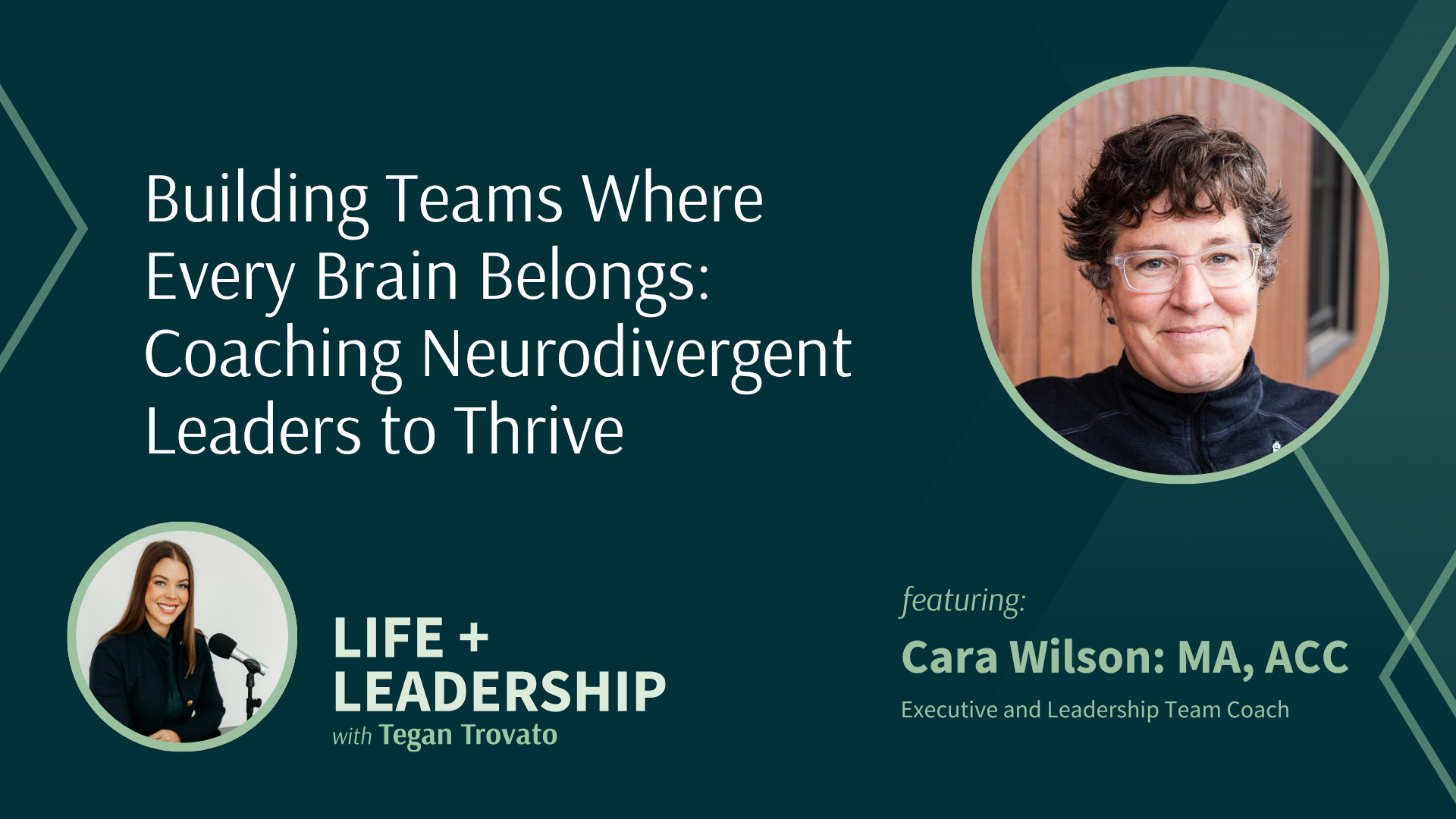
In this episode of Life + Leadership, I’m joined by Bright Arrow coach Cara Wilson, whose work focuses on coaching neurodivergent leaders. Cara brings both professional expertise and deeply personal experience to this topic, helping organizations make more room for different kinds of brilliance.
Cara shares her own journey of discovering her ADHD and autism diagnoses later in life and what it taught her about identity, leadership, and inclusion. We explore how leaders can better support neurodivergent team members, the nuances of coaching in this space, and the courage it takes to show up authentically at work.
Discovering Neurodivergence as a Path to Self Understanding
Cara’s story began with curiosity. After earning her master’s in applied behavioral science and spending years studying human behavior, she learned through an offhand comment from a friend that she might have ADHD. A later assessment confirmed it.
But the revelation did not stop there. Years into her coaching career, Cara noticed patterns that pointed to something more: autism. At age 52, she received a formal diagnosis. “It was revelatory,” she shares. “I’m not broken; I’m just wired differently.”
That discovery transformed how she understood herself and her clients. “I’ve always been obsessed with human behavior,” she says, “but learning about my own neurology helped me see how different brains navigate the world.”
The Extra Labor of Fitting In
Cara describes what she calls “masking,” the invisible work neurodivergent people often do to fit into environments that were not designed for them. From making constant eye contact to suppressing physical movements that help regulate energy, the effort can be exhausting.
“It’s extra labor,” she explains. “And whether you know you’re doing it or not, it takes a toll.”
Through her own experience, Cara learned to listen to her body’s signals and to set boundaries before burnout strikes. She even coined the term “coffin time” for her restorative ritual: lying under a weighted blanket with noise canceling headphones to reset her nervous system. “Twenty minutes of stillness,” she says, “and my battery fills back up again.”
The Language of Neurodiversity
One of the themes we unpack in the episode is how language continues to evolve around neurodivergence. Cara emphasizes that terms like high functioning or low functioning are outdated and often harmful. Instead, she encourages asking people directly what language feels comfortable for them.
“Not everyone relates to the word neurodivergent,” she explains. “Some prefer neurocomplexity or even neurospicy. What matters is respect and curiosity.”
She also reminds leaders that neurodivergence does not need to be fixed. “It just needs room,” she says. “Neurodivergent people are like the canary in the coal mine. When we struggle in a system, it signals that something is not inclusive for anyone.”
Coaching Through a Neuroaffirming Lens
As Cara and I discussed, executive coaching for neurodivergent leaders shares many elements with traditional coaching such as stakeholder feedback, assessments, and development plans, but it also requires a different kind of attunement.
“A neuroaffirming coach understands that these leaders are often working harder than everyone else just to function in systems built for neurotypical brains,” Cara says. “We tailor strategies that work with their wiring, not against it.”
For some leaders, that means building structures that support executive function challenges. For others, it is learning to regulate sensory overload or navigate social dynamics without self criticism. Above all, it is about creating a coaching relationship grounded in safety and understanding.
I shared with Cara that part of what makes her partnership with Bright Arrow so special is the lived experience she brings. “There are times when a client needs a coach who shares their lens,” I noted during our conversation. “It is validating in a way that builds real trust.”
Creating Inclusive Workplaces for Every Brain
When we think about inclusion, neurodiversity is often overlooked, but it should not be. Cara encourages leaders to start with simple, practical steps:
- Ask your team members what helps them do their best work.
- Offer information in multiple formats, both verbal and written.
- Reexamine “norms” like always on cameras or rigid schedules.
- Provide clarity, because structure benefits everyone.
These practices do not just support neurodivergent employees; they strengthen entire teams. “When you build environments that are flexible and explicit,” Cara says, “everyone benefits.”
Courage, Curiosity, and Care
Cara closed our conversation with a reminder that inclusion is an act of leadership. “The world would be a better place if we made more room for different kinds of brains,” she said. “Right now, that is an act of courage.”
I could not agree more. This conversation reminded me that effective leadership is not about uniformity. It is about making space for difference, leading with curiosity, and creating workplaces where people feel safe to show up as themselves.
People in This Episode
Cara Wilson – Executive and Leadership Coach, Bright Arrow Coaching
Tegan Trovato – Host, CEO of Bright Arrow Coaching
Transcript
Tegan Trovato
Hey there, welcome to the life and leadership podcast. I’m your host, Tegan Trovato, founder and CEO of Bright Arrow Coaching. In this show, we dive deep into how leaders like you can turn business challenges into personal growth opportunities.
Whether you’re a seasoned executive or an aspiring leader, this podcast is your go to resource for unlocking your full potential in both your professional and personal life. Join me as we hear from executives, experts, and innovators about their leadership journeys and learn how to develop better strategies and activate them for success. So if you’re ready to fuel your journey to becoming an extraordinary leader who makes a lasting impact, you’re in the right place.
Let’s dive in. Today, I’m joined by my colleague and Bright Arrow coach, Cara Wilson. She’s one of the most insightful coaches I’ve had the privilege to work alongside.
Why Neurodivergent Coaching Matters
Cara works with all of our clients and one of her specialties is in coaching neurodivergent leaders, and she’s helping us bring this important specialty into our practice. In this conversation, she shares her personal journey, unpacks what neurodivergence really looks like in corporate life, and helps us see how organizations can leverage and make more room for different kinds of brilliance. Cara Wilson, welcome to the podcast.
Well, hello, Tegan, it’s lovely to be here. So glad to have you today. This is gonna be so fun.
Listeners, Cara is one of our most sought-after coaches here at Bright Arrow. We’re so lucky to have her partnership in supporting our clients, and she and I get to do some team coaching work together on occasion. And so I’m excited to introduce you to her today and for you to get to hear some of her story.
One of her specialties is coaching neurodivergent leaders, and that is something we now offer through our practice at Bright Arrow. Cara is one of the brilliant coaches who’s specialized in being able to support as a specialty in that area. So we’re going to talk about that today.
We’re going to talk a bit about why that specialty is important in corporate America and inside of organizations, and then we’re lucky enough that Cara has agreed to share some of her personal journey in this vein with us. So to start off, I want to just make a declaration for myself, selfishly, that I’m learning too, as I go, about what’s the right language that we use here. And Cara, I know in our prep, you’re going to educate us a little bit about how it depends.
But what I would invite as my partner today, Cara, is that if I don’t use the right language at any point, I would invite you to correct that or to educate me if you’re willing, because I do want to get it right, and I don’t think I know everything in this area. So we can model that for our listeners, that this can be how we do it, if that’s okay with you.
Cara Wilson
Yeah, of course. Of course. And what’s right with me might be not right with someone else.
That’s one of the interesting things about this population is that we all kind of have our own language that we appreciate.
Tegan Trovato
And how you refer to the neurodivergence experience. Okay. Good.
That’s good to know. Well, why don’t we start off with why this has become one of your focus areas as a coach? Yeah.
Cara’s Discovery Journey
Cara Wilson
Yes. So when I finished my master’s degree, I was in my early 30s. It’s called Applied Behavioral Science Coaching and Consulting in Organizations.
And my girlfriend at the time was a therapist. And she said, you know, you’re ADHD, right? And she pushed me to go for an assessment.
And I didn’t know that about myself. And I went and I am indeed ADHD. And it was really interesting to learn that in my 30s, after finishing my bachelor’s degree and a master’s degree, and having some pretty unkind stories about myself as a student.
And it kind of unlocked a lot of my perception of myself growing up and like, even thinking about me being a little kid and how, if I had the right teacher who provided like the right kind of structure and stimulus and dopamine for my little super active brain, I was a really good kid. I was a straight A student. And if I didn’t have that kind of teacher, I was like a hellraiser who got kicked out of class.
So that was very interesting. As I was getting into this career to learn about myself, and I’ve always been obsessed, literally obsessed with human behavior and understanding why humans act the way they act. Since I was a kid, I can remember watching that.
And I got a job in 2016, I got a job at Tableau Software. And I was an embedded coach with the engineering team. I did that role for five years.
And it was really interesting and a great education for me about working with a different kind of brain. And when I started my own business a few years ago, I got curious about, at first I was like, what is it about engineers that I like? What is it about that population of engineers?
And then I was like, you know, there’s a really high incidence of neurodivergence in the engineering community. I should learn more about that so I can be a better coach. And then the more I learned, and the more I learned specifically about autism, the more I started to attribute a lot of those characteristics to myself, started keeping a list of things that I had noticed in myself that were associated with autism.
And when the list got to be two and a half pages long, themed, it’s when I decided, okay, I think I’m on to something here. And I’m going to go and talk to someone. And I went and found a neuroaffirming autism assessor and had a conversation with them.
And they were like, yeah, you figured yourself out. So at 52, I learned, after like a lifetime of being really pretty introspective at 52, I uncovered that I was not only ADHD, but also autistic. Wow.
Tegan Trovato
Oh my gosh, I have so many questions. We’ll see which ones you feel like answering today. I think what comes up first is just a reaction to knowing you the last few years, and then having shared network in common, like people who’ve worked with you for a long time.
And people described you as this just super insightful, high performer, just really brilliant and talented. Also my experience of you, but people have talked about you like this for their decades of work they’ve done with you. What comes up for me though, is how much maneuvering you may have had to do.
Because we know that, you know, corporate America is, it’s kind of like, hi, this is how we should all think about things. Go in this box. This is how we do all the things, this process.
It’s very linear. And it doesn’t work well for most of us, but it certainly cannot work well, I would imagine, for those who are neurodivergent. So would you care to share about some of those coping mechanisms, if it’s not too triggering or painful, what feels appropriate here for you to share?
Masking, Maneuvering & Burnout
Cara Wilson
It’s so interesting the word you used, maneuvering. I haven’t thought about that word. The word that I’ve been using is masking.
And what worked for me is that I chose this special interest area of humans from a very early point in my life to watch and study. And that gave me an edge in terms of being able to maneuver and function in a neurotypical environment. I didn’t even really know I was doing it.
I didn’t know that I was covering for my own nervous system in this way until my nervous system kind of crapped out on me. And I hit maybe a lifetime wall, which happens to a lot of late diagnosed folks. There’s something called autistic burnout, which is it’s basically like your nervous system is like, we are done covering for you.
And so then things started to be challenging for me that had never been challenging before. And it was really did a number on me there for a while.
Tegan Trovato
Yeah. And I don’t want to put words in your mouth if it’s not maneuvering and it’s masking or if it’s some of both, maybe. Masking feels really different from maneuvering.
Cara Wilson
A lot of neurodivergent people have to cover for themselves in some ways in order to fit in in an environment that wasn’t built for them. And that’s exhausting. And it’s exhausting whether you know you’re doing it or whether you don’t know you’re doing it.
But, you know, some of the ways in which neurodivergent people can be more comfortable, like not making eye contact is one that is kind of expected in our society and especially in the work world. And that can be really hard for some neurodivergent people. And people like to like move their bodies and be able to, you know, if you’ve heard of the term stimming before, it’s like being able to do something to release maybe excess energy.
I have like little things on my desk that keep my hands busy while I’m talking. But sometimes those things are perceived as not OK or inappropriate. So the work that neurodivergent people have to do in the workplace to fit in is extra labor.
Tegan Trovato
Yeah. Yeah, it sounds like it. We have a team member at Bright Arrow who is open about her neurodivergence and she will just tell me, like, there’s a thing I plan to have done today.
It’s not giving me enough dopamine. Like, I’m going to have to delay this until tomorrow and see if my system can do this hyper analytical stuff. And I appreciate that we’ve created an environment where she can say that and we’re running the organization in a way where there’s space to use the space the way we need to.
But I’ve come to learn a lot through her and her sharing about like the nervous system and needing dopamine hits for certain things. We all need dopamine hits for things. But what I’ve come to understand, and please correct me or add on to this as appropriate, is that the ability to get those dopamine hits is so important for the brain to produce what you’re trying to get it to produce.
Under pressure, might I add.
Cara Wilson
Exactly. And sometimes we need it. For me, one of the wild things about autism and ADHD is that autism thrives on predictability and routine and ritual and calm.
And ADHD kind of thrives on excitement and dopamine and stimulus. And so there is this is like threading this needle for me that is really interesting. Like I need enough stimulus.
I feel this in work. Like I need enough stimulus. I need to be busy enough that it keeps me moving and I can tip over the edge really easily.
Tegan Trovato
Fascinating. I mean, I get to call it fascinating. It’s also laborious sounding and tedious.
So there’s some other things I hear. You know, you’ve mentioned a few terms that maybe we should like slow down a little bit, level set for listeners. We use neurodivergence as a humongous bucket.
You’ve said things like ADHD. You’ve said autism. Can you give more definition around some of these things or even maybe add some other language?
Like what are some other things that fit into that neurodivergent bucket that our listeners may not be conscious of yet?
What Neurodivergence Includes
Cara Wilson
Neurodivergence as a term, and it really only came to be a term in like about the 90s, is when thinking started to make its way into the mainstream that was like, this is actually just a variation on our neurology. This isn’t a problem that needs to be fixed or cured. It’s like biodiversity.
We actually kind of need it for healthy functioning systems. Right. So the term neurodivergence is relatively new around that.
And some of the characteristics or things that fit within that bucket include ADHD, ADD, autism, things that people have probably heard of. Dyslexia also fits there. Dyscalculia, it’s like difficulty with numbers.
Dysgraphia, which is more difficulty with writing. And executive function disorder, which has to do with kind of just how we move through our everyday life. Like fun fact about me, I took the term executive function so literally for so long that I was like, well, I don’t have problems with executive function.
I get all my stuff done. I’m responsible. I’m reliable.
I do what I say I’m going to do. And it was actually just very recently, a few months ago, that I realized, oh, it takes like an overwhelming amount of energy for me to manage stuff, to run my business and to do all those things. It is fully exhausting.
And that speaks to my own executive function challenges. But I had only been thinking about it in terms of like how it affects other people and not necessarily how it affects me. There’s also sensory processing disorders, another piece of neurodivergence.
We know a lot and we also don’t know a lot about what causes neurodivergence. One thing that we believe comes into play, which has to do with synaptic pruning, as babies and as young kids, we’re born with more synapses than we need. And as we move through life as a baby and as a young person, our brain kind of trims off the things that we don’t need necessarily.
And in neurodivergent brains, less of that pruning happens. So we actually have just more synapses firing, which you could see relating to having like heightened sensory awareness and then also like pattern recognition and being able to pick up on things and solve things. If you know, neurodivergent people can be really known for like innovative problem solving.
It’s been really fun for me to learn about the brain and to learn about neurology and what we’re learning about all of this.
Tegan Trovato
You know, what comes up for me when you say we don’t know what causes neurodivergence, I’m going to go back to your earlier point where it’s biodiversity. I loved that concept of what this is about. We don’t all think the same way and we never have.
So I just think it’s interesting. Do we care about the cause if we can just learn to exist together with our differences and how we think and get things done? Yeah.
Cara Wilson
Well, and you can see that in the national discourse right now, some people think it matters and they’re getting information from like Tylenol does not cause autism. We know that it has genetic. We know that does have some environmental factors, doesn’t need to be cured.
It needs just to have room for it. And so there are two different models of looking at disability and not everybody considers neurodivergence a disability. Many do, but there’s two different models.
There’s the medical model, which looks at it as a disorder, a problem, a pathology that needs to be fixed. And then there’s the social model of disability, which says this is only really a problem because society has not figured out how to accommodate and make room for it yet.
Tegan Trovato
I appreciate you creating the difference there.
Cara Wilson
Yeah, it’s pretty starkly different, right?
Tegan Trovato
It is. And I’m sure if we look back, there are examples of ways we’ve categorized other things in the past being both ways and then left the medical, clinical issue behind and have incorporated some of our differences as non-medical issues. Right.
So we’ll continue to see how this evolves. There’s so much discourse. Unfortunately, it feels like we’ve gone a little backwards just in recent months.
But I think those of us who know intimately, especially adults, but certainly children who are considered neurodivergent, we’ve all been operating in the world together for a long time. The reality of this is about relationship and making space and upskilling on all sides. You have told me you’ve had to learn other ways to now take care of yourself.
Like we’ve heard about masking. And actually, before we go to how you take care of yourself, do you care to add more about the ways you’ve had to mask or maneuver? You know, what are some of those experiences that listeners who may be undiagnosed as neurodivergent may find in themselves or if they’re leading other folks or have colleagues who consider themselves neurodivergent?
What might we notice about how we’re having to cope or you’re having to cope?
Cara Wilson
Yeah, I think one thing that I’ve been tuning into lately, it is like I did not realize that there was a body below this neck business. You know, it means that I was totally checked out from some of the signals that I was getting from my body because I was so focused on making myself OK for the people that I’m with and that I’m around. I was really externally focused and I actually learned I got a lot of cues early on in life to shut down my own reactions and my own signals.
Especially, I think little girls, there’s such a steep consequence for little girls socially for not kind of learning how you’re supposed to be. Girls figure it out often faster than boys do. And then they don’t get clocked.
So they don’t necessarily get the support or recognition of whatever might be there. Right. And so for me, a new thing for me is paying attention to what’s happening internally for me and noticing when I’m over my limit.
I was at a conference a couple of weeks ago. Something bananas in me made me sign up to go to a dinner like after the conference because actually they said this will be in a small private room. If you have sensory stuff, this will be great for those kinds of conversations.
And I was like, this sounds fun. I’ll go to it. And I signed up for this dinner and I got in this room, which was about 20 people.
And the host actually have conversations with each other in small pairs. And the din in the room was like unbelievable. It was so loud.
And I was trying so hard to make eye contact with this person that I was talking to and be like a good conversationalist. And my brain was glitching out. And I actually had to stop the conversation and say, I’m so sorry.
I’m really having a hard time focusing here. And I’m not sure that I would have noticed that before or had the presence of mind to actually say something or ask for what I need.
Tegan Trovato
That’s a great example. Now, I’m just like, that was interesting neurodivergent dinner bait that they served up on that.
Cara Wilson
They got you there. I feel like there was a good intention and it just like in execution, it didn’t quite come through. I’m much more attuned now to my like social battery and to what things are going to spend it and then also learning like what actually replenishes it, what’s actually restorative to me.
Tegan Trovato
I know this is going to be different for each person probably, but what are some of the things now that you understand in these last few years? What are some of the things that recharge you?
Cara Wilson
I’m laughing because my husband, Wayne, and I have come up with a term that we call coffin time. Say more. And it is like I get in a room by myself and I lie down and I put a weighted blanket on.
I have noise canceling headphones and I listen to like really super chill music and eye mask. And I just basically act like I’m dead for 20 minutes and go internal 20 minutes and I can watch my battery fill back up again. And like 52 years, I didn’t know that that worked, you know?
Tegan Trovato
It’s been really great. Well, and the things you’ve described are classic nervous system calming treatments, right? The weighted blanket that just removing stimulus with light.
And so I can appreciate that. That’s amazing.
Cara Wilson
And what’s been wild for me is that as I discovered all this, I’ve just been deep rabbit hole into learning about everything. And I’m like deep into Reddit threads about how do people manage sensory differences and just trying to learn. And I would read, somebody would say, wear noise canceling headphones.
And I would be like, that’s not going to do anything. My brain did not understand what I needed. And then I would try it.
And like I started wearing noise canceling headphones in the airport. And I was like, this is game changing. This is life changingly helpful.
So not only do I not know what’s good for me, but when my brain hears an idea, it pooh poohs it. So I’m actually. I have to try things to see what is actually working.
I’m really learning things for the first time.
Tegan Trovato
That’s amazing. You know, when you we opened, we kind of set the stage about language use today. And you made the point of, you know, language you use may not be what language another neurodivergent person uses.
So can you tell us more about that?
Language, Labels & Safety
Cara Wilson
So some folks use neurodivergence and then others, I have another colleague friend who is a coach. She doesn’t appreciate that term because it feels to her like we’re not an anomaly.
She uses neural spicy. I’ve also heard people use neuromajority and neurominority or talk about neurocomplexity. Language is so interesting, right?
And it’s so important to think about the ways that it has evolved. There’s like stigma attached to different terms. There’s much less stigma attached to ADHD than there is to autism, in my view, and in what people are willing to say and talk about at work.
And that’s like another topic that we could come to is like the safety or not of being out at work and asking for what you need at work as the science and understanding about neurodivergence has evolved over the years. So has some of the criteria, the diagnostic and statistical manuals. The DSM is kind of the Bible of how people talk about and diagnose with neurodivergence.
And what’s kind of interesting about it is that the criteria mostly have to do with the impact of neurodivergence on other people and not necessarily on the person, which like that kind of blows my mind. Right. So if you are a person who masks pretty effectively, you may not actually get clocked by some of the diagnostic criteria.
Was it related to the DSM? It was. The DSM criteria are mostly designed around the outcomes or impacts of neurodivergence versus the internal experience of the person who is neurodivergent.
Tegan Trovato
What a miss.
Cara Wilson
Yeah.
Tegan Trovato
What a terrible miss.
Cara Wilson
Yeah. It’s really interesting stuff. And terms that we’re kind of moving away from have to do with things like high functioning or low functioning.
Tegan Trovato
Yep.
Cara Wilson
That makes sense. And I think best practice is to ask someone what language they’re comfortable with.
Tegan Trovato
Great. What are some things we know we should not be saying at this point? So high functioning, low functioning.
That sounds pretty clear. I feel like I also have heard this is old, outdated language, but what else? Or even like responses people may give when you share.
You’re laughing, which means you’ve had your own juicy experiences with that.
Cara Wilson
Yeah. It’s like, you know, I went through a coming out process of being gay when I was 30 and it’s like this whole thing where you have conversations with people in your life and they say, but I didn’t know. And how did you know?
And what does this mean? And it’s like, this is happening to me again as I tell friends. Who doesn’t want to do that twice, Cara?
That sounds so fun. Right. So some of the things that I have heard that feel less than great, less than stellar, one is everybody’s a little on the spectrum.
I think the intention when someone says something like that is to join and point out commonalities. But I think the impact of it is that it really dismisses how difficult it can be to be a neurodivergent person in this society. And if you’re talking about the spectrum of humanity, yes, everybody’s on the spectrum of humanity.
But if you’re talking about a spectrum of neurodivergence, everybody’s not on it. And just because someone might have a couple of characteristics that doesn’t necessarily mean that you’re fully having the same experience as somebody who’s autistic or ADHD or neurodivergent in some way. And I can just tell you that when I’ve had friends say that to me, when I share this information for myself, and that one does not feel so great.
Tegan Trovato
Yeah, we can imagine.
Cara Wilson
Yeah. Another one is that, and I think we kind of just spoke to this, but that neurodivergence needs to be fixed. It doesn’t need to be fixed, just needs to be included.
And I really like this idea that neurodivergent people are like the canary in the coal mine. You know, the miners in the UK used to take canaries into the coal mines to let them know, because the canary would know before the miners knew that the oxygen levels were getting dangerous. And so neurodivergent people in your system who are having a harder time in your system are giving you information about how inclusive your system is.
Tegan Trovato
Ooh, love that. Wow.
Cara Wilson
Yeah. You can’t tell that someone is neurodivergent by looking at them. So another reaction that I’ve gotten from folks is like, you don’t look autistic.
You don’t act autistic. And I’m like, what does autism look like to you?
Tegan Trovato
Yeah.
Cara Wilson
And we have like Hollywood to thank for that, for like Rain Man and for the ways in which we depict mostly white men as autistic and like the brilliant asshole stereotype. Yeah. Neurodivergence comes in all shapes and sizes and flavors.
And you may or may not know. And one of the things I say to my friends when they say that is, I’m working really hard for you not to notice it, actually. The labor is happening inside here, you know?
Wow.
Tegan Trovato
And when you think about that labor, there may or may not be anything here that’s different from what we’ve covered. So if we just move on, let me know after this question. But I’m curious if there are particular nuanced challenges if you’re a leader who identifies as neurodivergent that you may just face with the responsibilities of a leadership role that would be different from being an individual contributor.
Nuances for Neurodivergent Leaders
Cara Wilson
Yeah, absolutely there are. And one that I’ve alluded to a little bit already is just that they need more rest to be able to take care of themselves. That it really behooves us to know ourselves and know what we need.
You know, when I was talking to the assessor and I was sharing some stories about my kind of lifetime of being hard on myself, and what they said to me was, that way in which you held yourself, that standard that you held yourself to is internalized ableism. That is you expecting yourself to behave in a certain way according to neurotypical standards. And I remember being like, what?
I’m going to have to go home and sleep on that because that’s so big. And that was one of the biggest things for me about figuring this out about myself that helped so much is to recognize like, oh, I’m not broken in the way that I kind of thought I was. I’m just wired differently.
It was revelatory and so helpful. And so whether leaders know that for themselves or not, it can be game-changing information to have. It can be helpful because then you can learn how to take care of yourself.
I think some neurodivergent leaders struggle with executive function. So being able to have systems and processes that are going to help you be successful for yourself, most productivity tools are designed for neurotypical brains. So like having someone that can help you in that way can be really helpful.
Tegan Trovato
So get real tactical. What comes up for me with that is like being able to keep a schedule and follow meeting cadences. And just to make this real for listeners, what are some other examples of executive functioning showing up in leadership if there’s more than that?
Cara Wilson
Yeah, having trouble task switching or context switching. This is not so much executive function, but one that I notice a lot and that is true for neurodivergent people is missing social cues and so not being able to maybe read between the lines of something and or being more direct and bottom lining something and being perceived as brutal or too direct or rude. I coached a senior, he was an SVP of engineering who had a diagnosis of Asperger’s, which is actually no longer used as a diagnosis, but that was how he self-identified.
Didn’t want to be out to his staff, didn’t want them to know about it, but he struggled with being able to regulate the way that he spoke with people. So when he got excited about stuff, he came across as if he was angry, it was really like an overuse of passion and so for him it was really hard to gauge what was an appropriate amount of passion to show in conversations and he was landing on his people as kind of an asshole.
Tegan Trovato
Yeah, yep, I can imagine that. I feel like we’ve experienced that, some of us, I can imagine. You’ve mentioned this a few times and I want to make sure we do not lose the thread about the safety of being out at work.
This is probably, you know, as someone who’s led people over the years inside of other companies and knowing the HR protocol of disclosing something and making accommodations, like it’s a very clinical like thing and I can imagine this falling into what I would call that trap. But take us more philosophically to the experience of being out that journey and then we can talk about some of the tactical parts of it.
Being Out at Work
Cara Wilson
Yeah, I think this is a very personal decision for people to make depending on their own comfort and their own feeling of safety within the system that they’re in. One thing that we know and that I’ve actually experienced in my coaching practice already in coaching neurodivergent people, neurodivergent people, if they are not in a system that knows how to accommodate them, they will get pushed out of the organization. So I know multiple people who have been asked to leave jobs basically because of the organization’s inability to accommodate some differences in that way.
So it’s a really big decision to think about, do I tell my workplace about this and ask for accommodation or do I not? And that’s something that I feel like people can only answer for themselves and it’s a very tricky space.
Tegan Trovato
Because it arguably could be a protective mechanism if you are out. But then also, whenever we share something super personal about ourselves, we don’t get to control who talks about it, how it’s talked about in front of us, behind our backs. I can feel the weight of that vulnerability as we’re talking about this.
Yeah.
Cara Wilson
And a lot of people are not educated about neurodivergence and so they have all kinds of stories about what it means. There’s research that shows, I thought this was fascinating, there’s research that shows that when neurotypical people meet autistic individuals, they don’t like them right out of the gate. They just don’t like them.
They don’t know why. But if they know that it’s an autistic individual, their brain actually, they can accommodate a little bit more for information about how things might be different and they’re less likely to dislike them, which I think is fascinating, right? And I even think about this for myself.
This is not my proudest moment, but I think back on people in my life who really irritated me. And I’m like, they were autistic. Like once a month, I have a revelation where I remember somebody in my life that I didn’t like, they gave me an allergy and I think on it now with what I know now about neurodivergence and I’m like, they were autistic and they were even rubbing me wrong because I was so obsessed with, we need to behave like everybody else in the world.
Like you’re not doing it right. All you got to do is copy and paste. It’s not that hard.
Why aren’t you doing it?
Tegan Trovato
Yeah. Wow. Fascinating.
And most likely many of them didn’t understand that they are neurodivergent possibly, right? So wow. This is where that unconscious bias and like, I have my own, I don’t know about, it’s impossible to walk the earth free of them.
But this is one of those that’s coming up as you describe this. I’m like, wow, this one sounds like it could be quite a prevalent one. We don’t even realize we’re doing it.
Cara Wilson
When someone shows up to you as blunt or too direct or too focused on being precise about something, you know, I think about my time at Tableau and the way in which a lot of those folks and I engaged, their brains are driven to find truth. They want to know like, what is the true actual truth of what we’re talking about? And they will do that sometimes at the expense of relationship.
And I had to learn when I was a coach there to not be offended by that and to realize that that’s how they’re learning actually. And they’re engaged and I should be glad that they’re engaged and they’re trying to figure out how to break something but it can feel really personal and like an attack because neurotypical society is, I think, more invested in harmony and relationships. And so those two kind of worldviews bump up against each other and it feels like a neurodivergent person is a jerk or is unkind or in whatever ways.
I had this thing happen a couple weeks ago. I was sitting on my porch eating my lunch and the FedEx guy drove up in a truck and I thought to myself, oh, they’re like timed. They’re on a tight schedule.
I will go down to the truck and I will meet him to get the package so he doesn’t have to walk up to the house. And I walked down and I stood in front of the door and he opened the door of the truck and he looked at me and he said, hello. And then he walked right past me all the way to the house and dropped the box off at the door.
And I thought, oh, he’s my people. He’s autistic.
Tegan Trovato
He’s doing the job. The job is going to get done to perfection.
Cara Wilson
That’s right. He’s doing the job and he’s not going to be taken off course. And he’s not into change or having that happen at all.
And my colleague Jill and I have a shorthand now, which is getting FedExed, which is when if my brain starts to glitch out in terms of a change, it’ll be like it just had a FedEx moment. You know, before I knew that, I would have thought that guy was a jerk. And now it’s like, oh, he’s on a different trajectory.
Tegan Trovato
Just what you modeled here that I don’t want our listeners to overlook is that that is what accepting others looks like. Just radically accepting others like you didn’t need to question why he did that. You didn’t take it personally that he did that.
He just did it. Right. And it wasn’t a huge assault on your life.
You’re fine. This was not an egregious offense. It was maybe a slight, if you will, violation of neurotypical social norms.
But also, who cares? But I just love that the way you described that was like, hey, he just did his job in front of me. There’s no problem here.
And that is what it looks like not to question everything everyone does around us. So thank you for that moment. Probably would have slipped right by it, Cara.
I just want to call that out really clearly. That’s what acceptance looks like in those around us. Right.
So while we’re talking about the nuances of coaching for neurodivergent leaders, what are some of the nuances of coaching for those listening in what we’d call a standard executive coaching engagement? We’re going to do assessments on a leader. We’re going to do psychometrics, understand their personality and their wiring.
We’re going to do stakeholder interviews to understand how the people around them experience them. We’re going to give the leader all of that feedback from their environment and from their own brains. And then we’re going to set a course for coaching like to two or three major growth areas for the executive over six to 12 months.
And we’d meet with them a couple of times a month. Sometimes woven in there are self-care conversations, how we’re going to help them cope or how they can help themselves cope and insurmountable stress. So I’m setting the stage for, you know, how we’re going to navigate difficult relationships and conflict.
So these are really common things that come up in almost all coaching engagements to set the stage. Where would you massage that, Cara? Like, what are you seeing that feels nuanced or vastly different from that description of coaching?
Cara Wilson
Yeah, first is just recognizing how much harder they’re probably working than everybody else. And creating a space that they can be themselves, show up, have somebody to talk to who understands what that feels like in the world, what it feels like to have that difference in the world. And somebody who gets the nuance of how can it feel like a professional liability sometimes and at other times feel like this incredible gift and incredible strength.
That’s what we mean when we talk about people having spiky profiles, like having these really extraordinary ways in which they’re exceptional and then other ways in which they might need more support. And I think that a neuroaffirming coach has an eye to those things and has an eye to spotting, like what I was talking about earlier with internalized ableism, being able to spot ableism and spot where they’re maybe having expectations for themselves that aren’t the right set of expectations and designing things that really work for their brains versus here’s what we know about what works for leaders.
It’s a little more of a tailored approach in that way. I have a coach, she’s life-changingly helpful to me and she’s autistic and she’s been through burnout in the way that I’ve been through burnout. And I cannot say enough about how seen I feel when I’m having conversations with her and how helpful it is to be able to talk through something that deeply impacts my life and have a safe place to talk about it and generate ideas.
Tegan Trovato
Yeah. And Cara, that is part of why we’re so grateful for your partnership too, because, you know, as I’ve cultivated our cadre of coaches, one of the things I’ve always had an eye for is diversity and diversity in ways you can’t see on the surface. And part of that is because there are chapters in our lives, maybe not always, but certainly chapters where we want to know that we’re safe because we can see ourselves in the person we’re working with.
And there are times when we need to work with people who are so different from us because we need this expansion chapter. Those things all belong. But this feels to me like one of those absolutely sacred, important areas that we need to be able to offer our clients.
The safety and the deeper validation, like I could validate a client who identifies as neurodivergent, like, yes, of course, this is hard. Of course, this is exhausting. It’s different to have a lived experience to validate someone from in this.
Cara Wilson
Yeah. And our neurodivergent leaders are already operating without that kind of, unless they’re really lucky, without that kind of community. It’s important.
Tegan Trovato
Let’s talk diagnosed versus undiagnosed. So I want to state clearly, and I’m sure you’ll appreciate this, but feel free to echo anything else that like a coach who specializes in support for neurodivergence is likely not qualified to diagnose anyone. Right.
So let’s be clear, that’s not our job. But if an undiagnosed, or if a leader, like, suspects that they themselves may be neurodivergent and doesn’t have a diagnosis, like, should they seek out a neurodivergent coach? How would you guide someone?
Because I think there are more undiagnosed than there are diagnosed right now. And if people are listening and they’re like, oh, my God, this is me. Kara’s story is my story, but I don’t have a diagnosis.
Does it make sense for them to reach out to a coach for support? What would you tell them? How’s this curveball for you?
That’s a juicy question. Yeah, it is.
Cara Wilson
No, it’s great. The preamble I would want to say is that not everybody has a diagnosis. And like what I said from earlier, that some people wouldn’t necessarily even register for a formal diagnosis necessarily.
And that now we know maybe you don’t want to have a diagnosis in your medical records. Like, there’s all of the weird political times that we’re in right now, too. And a lot of people self-identify and decide this is what works for me.
And if that’s the case, if you know that you’re starting to understand your brain in some certain way, a neuroaffirming coach can be really helpful. If strategies and tactics for neurodivergent folks work for you, who cares if you have a diagnosis or not?
Tegan Trovato
Well said. I, as a leader, would encourage all leaders and executives to assume you have team members who are neurodivergent. So let’s just set the stage.
Oh, you do. You do. You do.
So in that thinking, how can our listeners as leaders and executives be more inclusive or considerate? You know, are there ways that leaders can show up better in leading and supporting an inclusive environment when it comes to neurodivergence? Yes.
You could probably go on about this, probably a whole other episode, but give us what you can in a few minutes today.
Building Inclusive Teams
Cara Wilson
Yeah, yeah. I think that as leaders, we can build inclusive environments for our folks. We can ask our folks, neurodivergent or not, what do you need to be successful?
What are the ways of working that work best for you? We can offer clear and explicit communication. We can offer different ways to contribute.
We can think about ways in which our norms may not be serving everybody. So norms like everybody’s got to have their camera on. You got to make eye contact or giving only verbal instructions versus verbal and written.
Like just thinking about how might different brains benefit. And often people will know what they need, neurodivergent or not. Support people.
So support the structure of work by making things clear and explicit, which everybody benefits from, right?
Tegan Trovato
And also we do so much of that in team coaching. It’s insane. Like that’s the most of our work is creating clarity inside of a team.
So here’s to that. Yep.
Cara Wilson
I often think about the irony of like me having a very literal brain is that I get into these team situations and I can just bottom line shit because I actually need the clarity. And so I will be like, what are you actually talking about? Right?
Tegan Trovato
And this is why executive teams also love you, Cara, because they don’t want the fluff. They’re like, can we just bottom line this now and save ourselves an hour? So this is one of your gifts for sure.
Cara Wilson
Unfortunately, I only know how to bottom line.
Tegan Trovato
I love it. If we need a little hugging and fluffing, I got your back on that.
Cara Wilson
Yeah. Yeah. Yeah.
Tegan Trovato
I love it.
Cara Wilson
Yeah. So things like that, I think there’s just a lot of intersect between building inclusive environments and building environments that are going to work for neurodivergent people. Ask your people what they need.
Educate yourself so that you have a wider view than just kind of neurotypical standards. Reflect on your own biases and your own assumptions and give strength-based feedback. Like figure out what people are doing.
Like what are people’s strengths and how can you work to those? Super generic, but true. Yeah.
Tegan Trovato
Yeah. It feels generic till we put this lens on it, and then it feels really specific about why it’s important. So that’s exactly why we had this conversation.
So is there anything else you want to share today that I have not prompted you with my questions or any closing thoughts that’s important for you to leave our listeners with?
Cara Wilson
The world would be a better place if we made more room for different kinds of brains. And right now in the public discourse, it feels like there’s less room. And so it’s a real act of leadership and courage to create space for everybody.
And a lot of what we know about good leadership is like taking care of ourselves and modeling for our teams what that looks like and then taking care of our teams in that way. So it feels really important, especially right now.
Closing Reflections
Tegan Trovato
I agree. Cara, thank you. Thanks for your vulnerability.
This was a great conversation. And I just want to honor that this is a lot of personal stuff that you shared today with our listeners, and that was a vulnerable and courageous act. And you can just trust that this is going to echo out into the world in service to a lot of folks.
So thank you so much for trusting us and me and for your partnership.
Cara Wilson
Yeah, same. I love our work together. Thank you, Tegan.
Tegan Trovato
I’m so grateful to Cara for sharing her story and her expertise with us today. These conversations remind me that executive teams maximize the brilliance of all leaders through curiosity, compassion, and creating safety for people to show up as they are. If today’s episode sparked something for you, I hope you’ll take a moment to reflect on how your own organization can better support all the different ways people think, lead, and contribute.