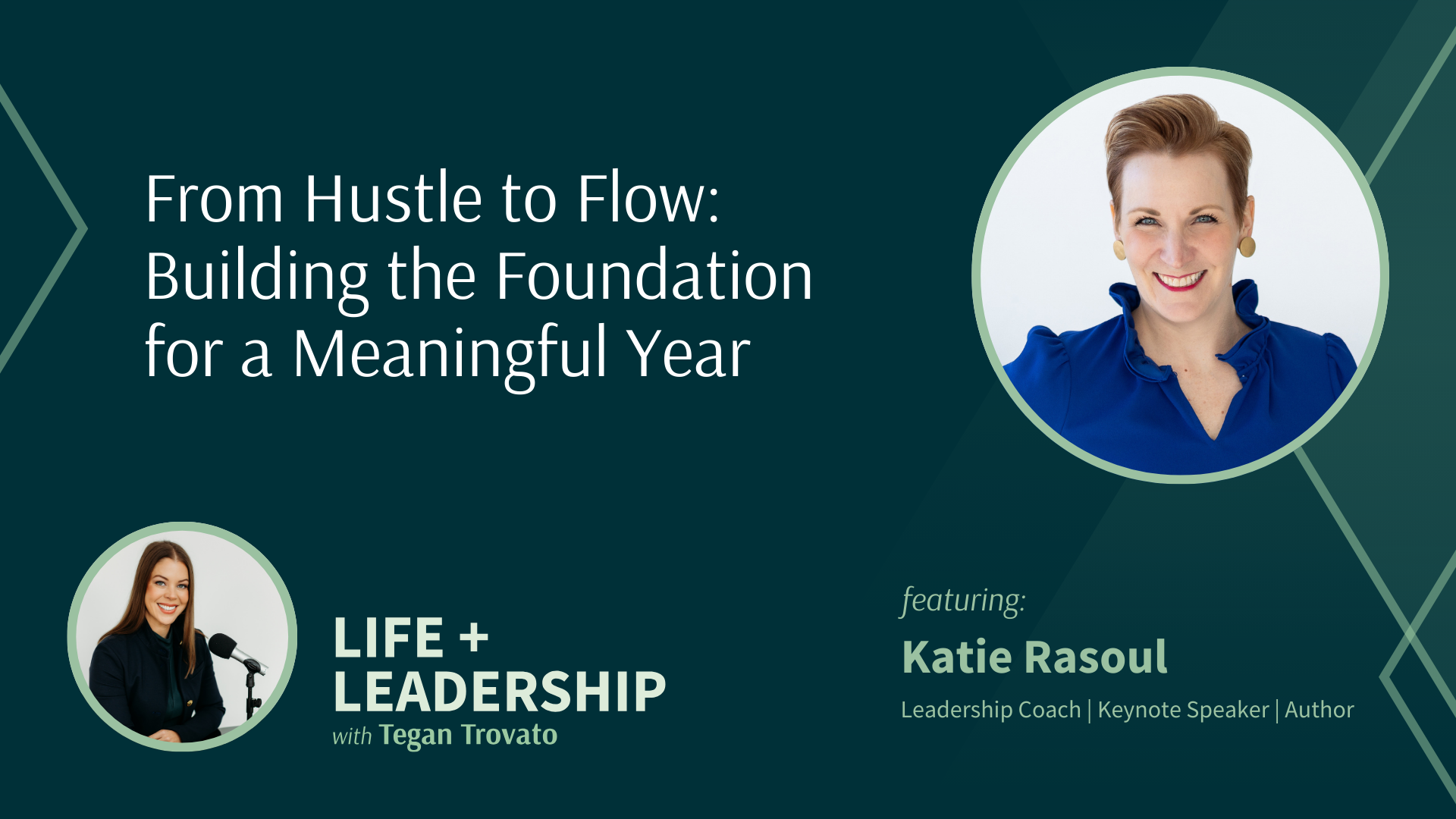
For executives, the end of the year often brings both urgency and opportunity. You are balancing financial pressures, strategic planning cycles, talent needs, and shifting market dynamics, all while navigating increasing personal and professional complexity. In this episode of Life + Leadership, Katie Rasoul and I explore a different kind of planning conversation, designed specifically for leaders who must make decisions in noisy, ambiguous environments.
Rather than focusing on traditional annual goal setting, we discuss what it means to plan with intention, intuition and presence, competencies senior executives need now more than ever. We share how our own planning frameworks have evolved in the face of life transitions, increased responsibility and the realities of modern leadership.
If you are a senior executive navigating uncertainty, decision fatigue or the pressure to deliver while remaining human, this episode offers a grounded, spacious approach to shaping 2026.
How Has Our Approach to Annual Planning Evolved and Why Does It Matter for Executives?
Our approach has changed because the leadership landscape has fundamentally changed. Senior executives today operate with more complexity, volatility, stakeholder pressure and operational pace than ever before, and planning must adjust accordingly.
In earlier seasons of our careers, we approached goal setting with intensity through detailed plans, structured frameworks and measurable milestones. Those tools were useful in their time, but senior leaders now require a more adaptive and resilient mindset. Katie describes her past as an era of relentless self improvement, fueled by discipline and drive. Today, she recognizes that sustainable leadership requires less striving and more internal clarity.
Similarly, my own planning once focused on designing learning paths and creating ambitious growth opportunities. Parenting, entrepreneurship and economic unpredictability have reshaped how I think about time, energy and what is truly within my control. Executives everywhere are facing similar shifts that include expanding responsibilities, shrinking margins for error and more people relying on their presence.
The planning approach evolving here is not about doing less. It is about leading from a more grounded center.
Why Should Executives Use a Word of the Year and How Does It Strengthen Leadership?
Executives benefit from choosing a word of the year because it simplifies decision making and anchors leadership presence in a rapidly changing environment. A single word provides a strategic filter for choices, priorities and leadership behaviors.
For more than a decade, I have selected a word that frames how I want to lead and not simply how I want to live. Words such as equanimity, vitality and compassion have shaped how I navigated team dynamics, growth cycles and board level decisions. For 2026, my word is flow, a reminder to lead with presence and momentum without unnecessary force. It aligns with the realities senior leaders face that include unpredictability, competing priorities and the need to respond rather than react.
Katie’s word, wayfinding, captures what many executives experience, which is the need to move through complexity without assuming the path is predetermined. It reflects openness, adaptability and strategic sensing, all essential leadership capabilities in ambiguous contexts.
A word of the year becomes a leadership tool that guides how you show up in moments of pressure.
How Can Executives Create Space for Intuition in a Noisy Leadership Environment?
Executives create space for intuition by intentionally reducing noise and carving out time for internal clarity, something rare in senior leadership but critical for sound decision making. Without space, leaders default to reactivity.
Katie describes intuition as one of her strongest leadership assets, but she notes that it only surfaces when she creates quiet, unstructured space. Creative practices such as writing, painting or walking are not distractions. They are methods for releasing mental tension so deeper insights can emerge.
In today’s leadership climate, executives face constant stimuli that include information overload, stakeholder escalation, economic uncertainty and organizational pressure. Intuition becomes harder to access when leaders operate from fear or urgency. I shared how I now proactively ask for support, blocking thinking time, taking intentional pauses and creating distance from operational noise so I can access strategic clarity.
Executives often forget that intuition is a form of intelligence. It functions only when we deliberately make room for it.
Which Planning Frameworks Support Executive Decision Making Today?
The frameworks that matter most for executives today are the ones that create clarity without rigidity. Leaders need structure, but they also need the flexibility to respond to shifting market and organizational dynamics.
I still use four planning domains which include financial, personal, health and business because they mirror the categories executives must balance year round. I now use them as guides rather than mandates, allowing space for recalibration as conditions change. I also reflect on two strategic questions that senior leaders find especially useful:
- Who or what were my greatest teachers this year
- What do I now know to be true
These questions surface insights that directly influence leadership behavior and decision making.
Katie also uses these categories but evaluates every goal through the lens of her word of the year. If a goal creates misalignment with how she intends to lead, she reframes or removes it.
This approach gives executives what they truly need: clear direction combined with adaptability and the ability to evolve as the landscape changes.
What Priorities Are Executives Carrying Into 2026 and What Can We Learn From Them?
Executives are entering 2026 with a renewed focus on sustainability, both personal and organizational. The priorities that matter most are grounded in well being, relational strength and community impact.
For me, this includes leading my family through a major transition, deepening our roots in Indianapolis and expanding the ways I serve the community, particularly around food insecurity. This work connects to my own childhood and reminds me that leadership is most grounded when it is connected to something personal and meaningful.
Katie’s priorities echo similar themes which include civic engagement, youth leadership and sustaining daily rituals that create emotional and cognitive space. These practices allow leaders to show up with focus and steadiness in the environments that depend on them.
The lesson for senior executives is this: your priorities should strengthen your leadership capacity, not simply expand your responsibility load.
How Can Senior Leaders Right Size Their Planning for a Complex Year Ahead?
Senior leaders can right size their planning by aligning the depth of their planning with their current leadership season, rather than with outdated expectations of constant optimization. Leaders cannot perform at their highest level when operating from depletion.
For some executives, detailed frameworks will provide clarity. For others, a single intention or word may be the most effective guide for the year ahead. What matters is that your planning approach supports your leadership rather than your inner critic.
As Katie shared, this conversation is permission to exhale, a reminder that leadership requires presence rather than pressure. And as I shared, this year requires leaders to be intentional, not perfect.
Right sizing your plan means choosing a way of leading that is sustainable, strategic and true to who you are, not just who your role demands you to be.
Resources
Additional resources to help you plan for your year:
Strategic Thinking Time Template
Webinar: Purposeful Executive Leadership
Previous podcast episodes with Katie on end-of-year planning:
2019: Year-End Review and New Year Planning 3rd Edition
2018: Do Less and Be More in 2019
2017: How to Reflect on 2017 and Plan for 2018
Connect with Katie on LinkedIn
Connect with Tegan on LinkedIn
Bright Arrow Coaching LinkedIn
Transcript
Tegan Trovato
Welcome back. Today’s episode is a special reunion.
My longtime friend and former co-host, the person who co-founded the podcast with me, Katie Rasoul, is back with me to dive into one of our favorite annual conversations. Annual planning and goal setting, how we close out the year with intention, and how we shape the year ahead with clarity. We’re going to take you on a journey to listen to how we used to do this in the past versus how we plan now, the benefits of each.
And you’ll hear today that we are now planning with more ease, more intuition, more presence, and a lot less pressure. So we’ll talk about the shifts in our planning that come with parenting and entrepreneurship and shifting values in our lives, and simply just being human beings in a time of constant change. Of course, we’re going to share our words of the year for 2026, our personal priorities and the practices that still help keep us grounded all year long.
Whether you’re a structured planner, an intuitive feeler, or someone craving permission to create more space in your life, this conversation will meet you where you are. I’m so glad you’re here. Let’s get into it.
Reconnecting & Looking Back
Katie Rasoul, welcome back to the podcast.
Katie Rasoul
It’s so good to be reunited here. Thanks for having me.
Tegan Trovato
Are you kidding? It’s so weird for you to say thanks when you and I gave birth to this thing together. We created it together.
So I have just been so eager to be back in the saddle with you get the band back together and just flow the way we flow in our conversations.
Katie Rasoul
Same, friend. And I feel like anyone who’s been listening for a while will appreciate our updated conversation around this topic.
Tegan Trovato
Yeah. Yeah. So listeners, if you aren’t familiar, Katie and I for years were, you know, co-hosts of the Life and Leadership podcast.
And every year we would do a reflection and planning episode. So as the year would end, we’d reflect on the past and we would talk about how we were going about our planning for the new year. And we wouldn’t just talk about it.
How We Used to Plan
Some years we got together in fancy hotels and holed up in fancy, expensive breakout rooms for days at a time to think about the future and to plan it together or alongside each other, right? Make our own plans alongside each other. So I’m sharing this because Katie and I have looked at so many frameworks for how you set goals and how you plan an intentional year.
And I thought it would be really cool to get back together and for you and I, Katie, to talk about how do we do it now? You know, life has changed. Things have changed.
What we value has probably changed over these years. I know I’m certainly looking at goal planning and reflection really differently than I have from years ago when you and I first talked about it. So let’s reflect on how we used to do it.
How about we start there? What comes up for you when I say, hey, tell our listeners how we used to do this thing called annual planning and reflection?
Katie Rasoul
Yeah, we would collect all of like, oh, there’s this bit over here and I’m going to do this over here and I’m going to make a big poster and lots of there were many post-it notes, right? We would really dig deep and more time than certainly the average person would spend really reflecting and pulling all these bits of our lives together. And surely some of that is the same in the sense of the what, but the how I imagine.
How We’ve Evolved
I know it’s very much evolved for me in how I pull those bits together and what question I’m trying to answer, I think now might be different than I was even five years ago, which is probably the last time we recorded this exact episode, annual episode. And I think my whole DNA has been rewritten since then. So certainly I’m a different person and my approaches changed to be less over the years.
Tegan Trovato
Yeah. Could you say more about that for listeners? And then I will do the same because I’m feeling something similar.
But if you were to describe how you were back five years ago, the last time we recorded this, as opposed to who and how you are now, how would you describe those two versions of yourself?
Katie Rasoul
Yeah, that’s a good question. I think in the past, I was in an era of relentless self-improvement, I guess I would call it. And that was a good thing.
I don’t say that with judgment on it, but it was very much a drive and an interest to really dig into the details and really think about what the goal is going to be and set the goal and how am I going to get there. And that took a lot of detail, took a lot of discipline, took a lot of drive. And that worked really well for me for a long time.
And now I can see where I feel a sense of diversifying where I spend my time and attention. Like I’m not putting all my eggs into a work basket or a family basket. So I feel like I’m spreading things out a little bit and really looking less about the goal, but the goal being more about how do I want to feel?
What do I want to practice every day or do every day to feel that way or become that person? Less than it being some sort of achievement down into the future. So I think that’s the biggest difference is it feels more internal, more local to myself, more ritual or habit-based and how I want to experience the year versus some sort of achievement, if that makes sense.
Tegan Trovato
Makes sense to me. And I’m willing to bet a lot of people are relating as they’re hearing you say this. So I think back to the several years in a row when you and I were doing goal planning together and sharing these with our listeners. And I had a similar drive.
I mean, it’s part of why we gelled so much and had so much to share with listeners. I also was really focused on creating learning opportunities. That’s how I would describe what I was doing, right?
I was really intentional about what I wanted to learn, which is a value I hold. Learning is one of my top values. And largely I had lived a life up to that point where I created those learning opportunities through work.
I created my career. I would say this is the thing I want to study or learn or grow within myself. And so then I would chart the course on how I thought I would learn those things.
I also had a ton of expendable time back then. It was before I had children. So it was all about me most of the time.
What a luxury. I think where I am today is learning is still a top value for me. I don’t think that’ll ever change for me.
What I appreciate about where my life is now, and I have my own child and my partner has three kids. So between us, there’s four children in our lives to love on. Things have also changed in the world as far as how I experience it and that I feel like even less is in my control than it ever has been.
And so the learning is coming without me having to try very hard. The learning opportunities are right in front of me. They’re embodied in these four children.
They are embodied in my business that, you know, we used to be able to make very thoughtful, predictable goals. And because of the way the economy has worked and the presidential administration has worked, there’s less predictability than ever. And so there’s a lot of reactivity, which is part of how it goes right now.
Oh, and then of course, the expendable time is hilarious, like bye bye expendable time. And I wouldn’t have it any other way. You know, like this is a beautiful chapter I’m in.
But I feel the need to be present to what the learning is supposed to be versus trying to control it, because I think it would shortchange all the people in my life who are living it with me right now. That’s how I’d summarize that.
Katie Rasoul
So beautifully said. I feel some same way, right? Like it is all available right here. I just need to learn and be with what is versus whatever false sense of control I thought I had at some point or could make my own way around it.
I feel so much less of that, just either both in time and sense of autonomy or control over just factors in the world that we live in. No one loves the feeling of like beating your head against the wall when you set your goal here and then the entire universe is conspiring to take you over here one way or the other. And so I’m feeling, right, the sense of being present with that and letting it teach me what it needs to teach me without having to sort of be in the Formula One driver’s seat.
Yeah. All the time. Yeah.
Tegan Trovato
And I don’t know about you. I still like a little framework. Like I am still doing some reflection on this year.
I am still planning for 26. But wow, if we stood my plan for 26 up next to my plan for 2016, you would think two different humans wrote the level of detail, right? Like 2016 was all measurable goals and very specific.
And 2026 is going to look a lot lighter. Like there’s just a few buckets and they’re really big. And I will fill them over the year with what comes my way versus needing it to be specific things going in the bucket.
And just like you alluded, Katie, all of that had value. And to the point, I will tag all of these. We’ll have our editors put them in the show notes so you can go back because there’s value in each of the years that we planned and the way we did it.
It will resonate for you or it won’t. Like this year’s episode may be exactly what you were looking for in terms of how you plan or you may want something more detailed. And if you do, go on and take 2020 and 2019, 2018, 2017 a listen of our episodes and see if some of those frameworks work better for you.
Words of the Year
I still love to do a word of the year. Same. Yep.
And mine for 26 has already come to me. We can maybe touch on that. Katie, you have yours for 26?
I do. All right. So we’ll come back to that in a minute.
Another thing I’ll say about those years of really focused goal setting and attainment is that it has changed the way I live my life to a point where I no longer have to set goals around certain things. For example, I focused very intensely on my health for a lot of years and weight loss and eating a particular way that makes me feel the best in my type of body, getting my weight to a level that feels best for my body. Now the goals are maintenance goals, right?
Because of so many years of focusing on that built habits into a lifestyle. And I’m sharing that because that’s a testament to the value of being conscious about how you spend your year and where you focus your energy. And now living that way takes way less energy.
It’s just the way I live. That’s one example. Katie, I don’t know if anything maybe comes to mind for you of something you focus on for many years that’s now it’s like table stakes.
It’s just what you do.
Katie Rasoul
Yeah. Oh, that’s such a good point. It’s a really good reminder.
Like those things came out of probably more intensive goal setting process. And right, those were things I used to wish for and work for. And now they are part of my daily life.
And a lot of mine of that example are health based. I protect sleep at all costs. My exercise routine has been probably five years and beyond, like, extremely solid.
And so being able to call those I really call those boundaries like sleep movement and 64 ounces of water a day are like boundaries that I will not let other people touch.
Those that did not exist in even 2019 probably was maybe the very beginning of that. So right. It’s a continue.
It’s not a start or stop. And there’s not a lot to do other than do exactly what you’re doing. And it doesn’t take a lot of energy.
And that feels great because I can do that. And it feels like I guess and I can continue to be great for my health and well-being and fine tune things along the way.
Tegan Trovato
So the goals became what is now the foundation for new things you want in your life. I love it. So word setting word of the year.
So the way I frame mine, and then you can tell listeners to Katie, how you view this experience. I’ve been choosing a word of the year since 2011. And I’ve kept track of them.
And that’s really fun to look back at. And for me, I don’t consider something for myself as having been learned until I embody it. And I can really teach it to others.
I think when we feel mastery enough to pass along some lived experience, we can’t say we’ve really learned the thing. And having a word for the year allows me to experience everything through that single lens. And that is a deep meditative mastery practice, right?
And you know, some people lose track of their word, it’s no big deal. Like, I just really love the practice. Like I will post it on my mirror at the beginning of the year, I will keep it somewhere visible in my car at my desk, and really ask myself as I experience my life, how that word is showing itself its lesson or how it’s, you know, unfurling for me to see more about what it means.
And so some words over the years, I’ve got this pulled up just for examples. Some of the words I’ve chosen over the years were like love, compassion, equanimity, being all in. So one year is a phrase, partnership, vitality.
So you can just feel how, you know, each of those words is big. And because they’re big, they offer a ton of experience through which to see your life for a 12 months period. So it continues to be the right thing for me that I keep doing that, and offering me a lot.
So Katie, how would you describe your experience with choosing your word and what it means to you to do that?
Katie Rasoul
Yeah, I still think it’s the single most important thing I do, when it comes to just directionally setting for the year. And it’s not like not to put pressure on it. It’s all this big thing.
But I think, much like you’re saying, I go back to it in the smallest of moments repeatedly. It’s like, am I living this word? This is what I said I wanted.
Am I living in this way? And my word of the year this past year was ease. Or, you know, another way to put it, maybe like an absence of struggle.
And so I would remember this, right, in moments of struggle being like, this isn’t how I wanted. This isn’t what I looked for in this year. What might I need to change right now?
And like, struggle’s good. It’s going to come, right? That’s part of life.
But it constantly serves as sort of a cardinal direction to say like, am I doing what I said I wanted this to look like? The year before that was grace. In the past, I’ve had phrases as well.
Like one was keep going. That was the one. One year was activate.
And so constantly go back to like, am I doing what I said I wanted to do to activate in my life? And that is a quick and easy way, but incredibly meaningful way to check in on am I living the way I said I wanted to this year? Yeah, I love that.
What’s your word going to be for 26? You know that sometimes they pop in, right? It appears to you and you hang on to it.
So my word for 2026 is wayfinding. And so what’s interesting and important about that to me is I’ve been feeling a little stuck lately in one place. And wayfinding really requires some sense of exploration, right?
You have to go somewhere to do any sort of wayfinding. And so it feels like an action word. It feels exploratory.
It feels open minded of like, you’re not sure what you’re going to find, but I’m open to seeing what that might be. And so that’s what wayfinding means to me this year is that it is meant to move me out of any place of feeling stuck, but be open and exploratory and enjoy the process. How about you?
What’s 2026 for you?
Tegan Trovato
You know, as I was listening to you describe yours, I was like, wow, there’s so much similar about the experience of my word, but it’s a different word. So my word is If I really were honest about myself, because of the level of intention and creation, there’s a lot of efforting in the way I’ve lived my life. And I, as you’ve heard, as listeners, you’ve heard me saying earlier today, like, I really appreciate this chapter I’m in with family.
And I feel very rooted in my life and very loved and very at peace. And, you know, next year, my partner and I are combining households, we’re blending families, my brother and his family are moving from Washington State out here to Indianapolis, where I live, he and his two children and wife. And literally, that’s all happening the same month next year, by the way, you know, you know, Travotos do.
Just all the way into the deep end.
Katie Rasoul
All in.
Tegan Trovato
Yes, that was a word one year, right? There it is. So with that, I appreciate that while this is a joyous time, it’s also asking many, many people in the same ecosystem all at once to change their lives.
And many of them are children. And I can appreciate that no matter how conscious my partner Mike and I are about how we do that and loving and how conscious my ex-husband is, Brian, about how loving he is with our kid and supportive he is of me and my new partner. It’s a disruptive thing.
And I need to be able to flow with that because any illusion I have of controlling and anticipating what that many people are going to need is hilarious. Like, I’ve lived enough to know, to know better. A couple years ago, my word was presence.
And so I really have been practicing, not just then, but even since then, like just showing up and really being in the moment. And I think that this is a year of practicing presence in a different way, which is a little momentous, a little momentum oriented. So presence with momentum equals flow.
That’s my idea. I just made that up. Do you like that?
Ooh, I do. I feel like that’s a good, that’s a good one liner. So that’s what I’m going to practice next year is just really going with how things move, how the children and the other adults in my life are feeling and doing what they need from me, what I need from them, and just going with it.
So we can put all the framework together. It is our jobs as parents and adults to structure things for our children. And then they need a ton of freedom within that structure to experience their lives.
And I just don’t have any need to control that. This coming year, I want to flow with it. The same is true for Bright Arrow for my business.
You know, I think that I’ve learned so much in the 10 years of owning this practice and growing it and being in partnership with Maggie, our COO. And this is what’s so humbling about being an entrepreneur. I’m 10 years in and we just had the hardest year, you know, like we’re ending the year really strong and it’s been a beautiful ending to a year.
But getting here was the hardest year we’ve ever had and hitting our goals. And I am the most experienced I have ever been. I am the most methodical I have ever been.
Right. I’ve got experience under my belt. And even with that experience, I couldn’t control all the factors.
You cannot. And so I am flowing with this business as well. Twenty four was weird.
It was an election year. Twenty five was weird with the administration changes and the economic disruptions. And we have no idea what 26 is going to be, but I’m here for it.
I’m going to flow with it. I’m going to treat this business like I always do, like it’s its own little person that needs tending to and nourishing. And I have expectations of it, like a good relationship.
Yeah. So we’re going to flow in business, too. You know, I just felt when the word came to me, I was like, this applies to the main components of my life.
It makes sense. And I want to practice it deeply. And it will take a while to build some muscle there.
Katie Rasoul
I love that and the thoughtfulness you put around it. And I actually like the equation you just came up with, because sometimes when you’re like, gosh, I am not in flow with this, it gives you some a little root cause, like I’m missing presence. That’s why I’m not in flow or I’m missing this bit.
Tegan Trovato
Yeah. Or I’m missing momentum. God, so such a genius.
It’s as simple as that. It’s just that easy. I got it all figured out, guys.
26, we’ll just skip it. No problem. So what else is coming up for you, Katie?
As you’re thinking about 26, and we’ve both very clearly stated we’re going to quit trying so hard on the goal setting, but what is the framework you’re going to use, if any? Or is it just a process? What would you let listeners in on, given the amount of accumulated wisdom you have on this topic about what feels right for you in terms of charting your course for 26?
Katie Rasoul
Yeah, I think there’s less clear and specified goals at the end, because if my word is wayfinding, I want to be in that space versus having the clear way found or assumed, right? I want to be open to a different ending. And so I want to approach this with more space and more intuition, which requires space.
If I feel like I am not able to create or be creative, if I’m not able to access the intuition that is an incredibly strong gift of mine, and so I know if it’s not there, I need to make space for that to exist. And so that’s my first step approach is continue to meet all of my basic needs that I just said, right? Sleep, water, movement, all of those things are going to be maintained, and really just allow space for my intuition to do its job, because I have never once been let down by that as a guide.
So I’m going to allow that space, certainly in the beginning, as I have to wayfind and make decisions, that’s going to be where I tap into is again, giving space for me to just intuit what I believe the answer to be. And I’m going to go from there. So that feels a lot less smart goal, right, than I’ve done in the past.
That’s uncomfortable, because I would love to be more clear about those things. But truly in the past several years, it’s like not just the word, but between the word, asking myself, like, how do I want to feel? And I asked myself, what do I want to say?
And if I were to boil it down just to those three things, the rest of it is kind of gravy. I think from a planning perspective, but if I know the answer to those three things, I can make pretty much any decision along the way or be heading toward the direction I set.
Tegan Trovato
Yeah, that makes sense. I love that. I mean, there’s so much wisdom you just shared about how intuition has to show up and has to have space.
And you are such a creative person. You’re so artistic, and you write so beautifully. And I know, yes, I know you have muscle you’ve built in creating a way for all of that to show up.
And I imagine into it, like, would you say the recipe is the same as allowing creativity show up as you would allow intuition to show up?
Katie Rasoul
Yeah. In some ways, it’s the same. It requires sort of space and permission.
Like this is of use. This is valuable for intuition. Creativity is valuable.
And so allowing that, I think, is of an important part for me. I also take creative breaks. Like if I’m doing writing, which is creative, but doing something that is kind of work, and it’s not flowing the way I want to, I will go plunk around on the piano, or play the ukulele poorly, or go paint watercolors.
I have no training in this. I’m not good at any of these things. But it’s just like use my brain in a different way, and use creativity as a way to break out of things that I’m feeling stuck on from a work perspective.
And so I create and allow space and see value in intuition and creativity for as part of the end product. It’s not a distraction. It’s part of the plan.
Tegan Trovato
Yeah, I love that. Well, we’re constantly coaching senior leaders on tapping into their intuition, because there is so much ambiguity, and we’re so short on data a lot these days, because things are moving so fast. And so I wanted to just take a moment to honor what you said about it, because I think that I would encourage our listeners as we enter a new year to try to create enough space to just get clear in yourself.
You have a lot of the answers that intuition speaks, right? So I just didn’t want to miss that low-hanging fruit there as we’re encouraging people into 26 to be conscious, to give space for intuition to show up. It’s so true.
Katie Rasoul
You have to allow the space for it. You can’t put 15 minutes on your calendar and then try and poop one out. That’s not how it’s going to work, right?
You need more time and space to really allow it to breathe. And so whatever time you’re giving it, if it’s not coming, just double it and go from there. I love that.
Tegan Trovato
You know, I’ve noticed, do we record an episode on intuition at one point?
Katie Rasoul
This feels like… I’m sure we did, actually. I’m sure that we did.
Now we have to go back. But I mean, it’s certainly been part of our lives and our coaching and our spiritual practice and so many things for years. And it certainly was covered or touched on in so many of our guests at some point.
You know, like feminine genius and there’s all sorts of other things that we’ve talked about that were so tied to intuition in addition to just making probably a full episode about it. So I think, you know, everyone has it. I’m lucky enough to know mine is really strong and I’m a very somatic person.
So I will feel things in my body. It is a whole body, yes, a whole body, no. And so I really have to remember that that data is all there and available as long as I’m willing to listen to it.
And it’s never sued me wrong.
Tegan Trovato
We don’t even start on this about intuition. We’re going on a rabbit hole. So please enjoy, listeners, please enjoy our intuition rabbit hole.
I’m very clear that when we’re in a place of fear, it’s really hard to access our intuition. And I will honor that most leaders are living a life at work that’s very fear oriented. It’s just the amount of stress we’re under, the risks we’re having to take, the toxic, often toxic environments we’re working in.
It can be really hard to get in touch with your intuition. So I want to be, you know, Katie and I are not being chill about this. Like we are understanding because we’ve also lived it.
And I still live it from time to time, how hard it can be to live your clarity when you are just living in deafening noise. So we’ll just say that. And, you know, I’ve had to find creative ways myself to do it as a busy working mom.
It’s how my word of the year shows up. That’s an intuitive practice. Like it shows up and I’m like, oh, there you are.
That is the one I now know. But when I don’t have enough space, it does not come. Like you have to create the space for it.
And I’ve had to learn to like ask my partner, like, I need to take two hours Saturday morning to think. I just need space to think about the business, to think about myself. And I couldn’t find it during the work week.
I might have to ask on the weekend of my partner to just back me up and help me out. Sometimes taking vacation time just for that and not using it for the family, it’s very valid. So rethink your 26 about how you’re going to create some space for yourself.
It can’t always all be at the gym. Like sometimes you need the quiet space, right? So it’s tough to balance all of our priorities, but I would really encourage folks in such a noisy time, we are in such a noisy time, like put the word noise on anything, your email, your phone, your house, politics, business, it’s noisy.
You have to find a way to make it quiet so you can hear yourself.
Katie Rasoul
Oh, I think that’s so true. That’s so true. And I, you know, I found so many times where I had to make a decision and something in my body was no, but sometimes fear and no, like intuitive no feel a lot alike.
So you’re like, am I wanting to say no to this because I’m afraid of it and maybe I ought to rethink that? Or is my body, is it just a no for me, like an intuitive no. And to know the difference and be able to sit and identify the difference between those things in a decision-making setting has been so valuable to be able to know the difference and have the space to recognize that.
So, you know, hopefully as people are trying to make decisions and things are noisy, that you can use this to say like, is this this intuition or is it something else and be able to parse those out.
Tegan Trovato
Yep. I love that. So I still am using a little bit more framework, of course.
No one is surprised to hear this. So I have my word of the year that guides me when I think about 26 and I reflect on the previous year. I look at were there tangible goals I set in the previous year and how did I do against those goals?
And then I set some, at least intentions, if not specific measurable goals in four key areas, financial, personal, health, and business. And the personal bucket can include all kinds of things, right? Family, other relationship, etc.
And when I reflect now, there’s a question I’ve been using for maybe just three years or so. I think, Katie, when I told you about this, you were like, ooh, that’s a new one. I asked myself who my greatest teachers were for the year.
I love that. Yeah. And this can be the teachers, can be experiences, they may be actual people.
Oftentimes my kid is making that list these years where she’s taught me a lot. And just the experience of being a mother is teaching me a lot. Anyway, big bucket to just ask yourself, like, what are my greatest sources of learning this year?
And then the next question I’ll ask in reflection is what do I now know to be true as a result of this year about myself, about anything? You know, what feels like truths with a capital T? And those aren’t always abundant.
Like, sometimes that list is one or two things. Like, to discover a truth with a capital T is a big deal, right? So I like to really search myself for what do I just know to be absolutely true to me for the rest of foreseeable time that this year has offered me.
So, and then I’ll take that exact same framework and plan the year ahead. So I’ll reflect on the word of the year, and then I’ll plan my word for the next year. I’ll reflect on how I did with my financial plan, and then I’ll set my financial goal for the next year.
So I have not done that for 26. I’m going to be looking for some of that solitude here in the next couple of weeks to really get clear on my financial, personal, health, and business goals. And of course, we’ve done our business planning for the year.
So those are set. Like, we know what 26 targets are, and revenue goals, and product development, all that good stuff is in place. But there’s something else as a business owner that I like to think about, like, you know, in terms of my own relationship to the business, how I am to serve the business.
You know, would I want it to be in a more purposeful and meaningful way outside of the mechanics of it and serving our clients also, right? So I need a little space, full transparency to finish my work on that. But that’s my framework now.
It’s that simplified, and it does not take me hours. I can spend hours on it if it feels good. Sometimes it does.
Some years I really do. I feel like this is one of those years where I’ll sit down for an hour, and I’ll be like, there it is. I’m good with this for next year.
And then I just will check in on it, you know, once a month, once a quarter. Sometimes we’ll get through a stretch where I just check in on those once a quarter. So, Katie, are you going to write yours down?
Like, what’s your process there tangibly, tactically?
Katie Rasoul
Yeah, I set the direction when I really think about how I want to feel, what do I want to say, what the word is. I mean, those are really just some sort of reiteration of my values, right? And then I do still go through this process of kind of what you’re describing, looking at some of these key areas, and being informed with what I just set.
Say, okay, I am going to work on these things personally, or I am going to work on these things in my business. That’s important. But are they going to meet what I said I wanted?
And that means, like, if I’m going to set a project out, or I’m going to set this goal, I really have to think through, and I hold myself accountable to, like, explain to myself how meeting this goal meets the goal of ease in 2025. And if I can’t answer that, then I really have to answer, what is it bringing to the table? Because if not, like, maybe it’s just, that’s not there.
So, I think I still go through this process of looking at all these financial, personal health areas, some of them I don’t have to touch. My health, I feel pretty good about the way that I’m approaching that. And then just look at a few key things.
Like, okay, I’m going to start Q1, working on these pieces. And then it’s maybe more of a Q1 check-in that says, did I do those things? Did they create the way that I said I wanted to be this year?
And then continue to iterate on the actual doing. So, I’m really clear on the being stuff. This is how I want to be.
And I’m just putting so much less pressure on the doing bits, because I can do till the day is long, you know. And I’m okay with having less structure at this season of my life on the doing and the exact what I’m doing for the entire year, as long as I’m honoring those bits of being that I put in place.
Frameworks, Priorities & Community
Tegan Trovato
What would you say some of your priorities are going to be for next year? I know you’ve been doing a lot in local politics and being super involved in your community. Tell us where that lands for you and anything else that you want to stake your claim in for 26 as priorities for you that your goals will probably support.
Katie Rasoul
Yeah, wayfinding is a bit exploratory and expansive in that sense. I definitely want to continue to work in my community. In fact, there’s a lot of local seats up for election this year that surely I’ll be a part of advocating for in my community.
I do youth sports coaching. I love doing all of these bits and pieces. And some of them are unpaid or some of them are, you know, not meant for the pay, you know, really.
And I want to continue to do those things. I think the other pieces that I am focused on is really the idea of habits or rituals to some degree. So maybe taking more walks in the woods, maybe doing morning pages more consistently, which if anyone isn’t aware what morning pages are, Julia Cameron, The Artist’s Way, that’s like a classic exercise where you would write three pages of whatever comes to mind at the beginning of the day to sort of clear out your mind.
Things like that, you know, it’s sort of building the ritual of how I want to spend my day to honor how I want to be. I’ve been really trying to take a tea in the afternoon, almost like a fika, like a tea break with myself and like an afternoon pause. And so this things like that are what I’m building in.
And so they feel very daily versus huge, you know, high achiever goals, which I’ve spent plenty of years doing that. And that’s been a fun way to look at this and like, am I living the way that I want to in these smaller moments?
Tegan Trovato
I also hear there’s an energy creation that’s happening through those things you’re creating, right? Like you’re, even the morning pages is like a flowing out, like getting some of the energy out to open your day. And then the tea is taking a little energy back.
And like, because I’m thinking in flow already, I’m like, look at that flow. Like, look at you creating how you want your day to feel. And to your point, that’s a big driver for you.
There’s a certain feeling you want. So I love that. I’m inspired by this afternoon tea.
Yeah. Is it the, I’m trying to think if this is the Swedish? I didn’t recognize the word you used, just isn’t familiar to me, but I was like, oh, I love the concept.
Katie Rasoul
So. Yeah. I feel like it’s Swedish and it’s generally taken with people and like, right.
Sometimes I’m, you know, like as a communal activity, well, like sometimes I’m alone, but I realized all the habits that I put down of like, how am I going to live are all space habits, really? I’m not trying to pack in productivity into those habits. They’re like meditation, walks, morning pages, tea.
And so all of that would be built space for the intuition, for the things that I want to cultivate versus like, well, if I go on this walk, I could get 20 more minutes in of my audio book. That is not what I’m doing on purpose, right? It is not meant to be productivity.
God, I love that. I’m fine.
Tegan Trovato
I’m like super inspired by that. To just be present to yourself a little more. I’m sure people listening are just falling out of their chairs with the idea of even having a little bit of that.
We used to live that corporate life of just running frenetically from thing to thing, never eating, barely using the bathroom throughout the day, much less taking a moment to breathe and have a tea and even alone. I think, well, there’s a loneliness epidemic across the US. We are not talking about lonely tea.
We’re talking about intentionally alone moment to take a breath. And I think there aren’t a lot of those either, especially on a weekday for a lot of folks. So I’m super inspired by that, Katie.
I love that.
Katie Rasoul
Well, I think that’s really important that you called out like, man, we’ve been there. I used to eat a whole banana from like floor four to floor one. And like, no one would even know that’s how fast I ate it.
Or like, no time to go to the bathroom, right? And while I fully recognize the privilege that I have to make my own schedule as someone who’s in their own business, I also, if I were to go back in to the lion’s den of a corporate culture, I would do it differently. And I think that so many, I didn’t understand how much control I had or how much control I gave away in those bits that I would make every effort to take back if I had the chance to do it again.
And so like, pee when you have to pee, right? Like, eat when you have to eat, take a break. And I just think that had I just required that of myself and of everyone around me, it would have happened.
And so I encourage you, even if you’re like, gosh, I’m just so busy, that doesn’t work for me, to say, what boundaries will you set so that you can live life the way you intend to and how do you communicate that to other people so that they can participate in that?
Tegan Trovato
God, I love that. It’s interesting. I’ve felt them, especially since I had Athena and now having expanded my family with my partner and having four little ones together in my life.
I’ve felt my priorities evolve and I love them. I love these priorities as much as I’ve loved my other ones over the years, right? We just step into them.
So I think for me, my priorities next year are family and health. I want everyone to be healthy and happy and well, and including myself and together and to feel supported. And I want to be more involved in my community.
That really started to wake up for me, or I started to awaken to it this year. And the way that was showing up is that I run a national firm. We have no brick and mortar.
I work from home. Our employees and coaches all work from home. And we are as together and consciously connected as we can be in the business.
And then largely I’m sitting in this space on this screen all day long. And I’m very committed to living where I live and raising my child here and not moving again. For those of you who don’t know, I’ve moved a ton in my life for my work and made a very conscious decision with my ex-husband to come here to raise our kid and to have her close to family.
And so three or four years ago, I just had this moment of like, I need to put down deeper roots. I’ve never really had to do this as an adult. I’m really staying.
And what does that mean? How do I want to feel when I’m out? And, you know, I want to run into people I know, not on the camera on, you know, at a coffee shop.
In real life. In real life. Yeah.
And so as silly as that may sound to some folks, for those of you who’ve been like me and been sort of a corporate nomad for a lot of years, you can appreciate when you finally land and you’re like, this is it. This is where I live. How lovely.
I really started to ask myself what I wanted to give to this community. If you’re in a local business, you can see the impacts of your business more readily. It’s not really the same when you, you know, don’t have brick and mortar, or you’re not providing a localized service or product.
It’s just different. And so I really started to ask myself how I could be more involved in my community. So I started looking more into board work.
And what’s interesting is, and so I certainly will do some board work locally. But when we saw the food programs in late 25 threatened and halted, I had a really interesting wake up call. You know, I’m such a privileged person at this point in my life, but I was not always.
I was a hungry kid with a single mom who relied on some of those benefits after my father died to feed us and we did not have ample food and we did not have certain shelter. And it’s talking about a whole different person because I live such a different life now. But I’m very lucky that I broke out of that.
Most people don’t. And when I saw those programs threatened, something else woke up in me in terms of my interest and making sure I stayed connected to that. Now that I am in a place of privilege to be able to impact it and make sure that the innocents and the unsupported in our towns continue to have basic needs met, basic.
Hungry kids should be fed. Hungry elderly should be fed. You know, like, so I’m sharing this.
This is the first time saying it out loud outside of my immediate family circle and friend circle, because I wonder if it will inspire some other folks to say, I have volunteered my face off over the years, and I’m happily so. But this was one of those moments where I was like voracious about my interest in supporting that thing. And so I’m curious what 26 brings in terms of that, in terms of really making sure that that basic need is met for families and children and underserved populations.
So more to come. But I feel like that’s where my community part is going to deepen. It’s not in having more entrepreneur buddies locally.
It’s not in being a part of the chamber. I’ve already got those things going. There’s something else that’s kind of waking up in me about community orientation.
So maybe we record another podcast at the end of next year, and I’ll give an update on that. But yeah, I mean, this isn’t new to you, Katie. I’ve watched you in your community.
You have voraciously been active in your community over the last few years. I’ve been very inspired by it. But it was the first time it felt this personal to me, where I was like, oh, oh, no, I’m gonna do something about that.
That I cannot watch happen, you know?
Katie Rasoul
Yeah. And thanks for sharing that here, just your story about that and your interests, your deep interest in that now. And as you were speaking, I just what came to mind was seeing something through, right?
Like local in your community, you’re seeing something through to fruition. I mean, someone is fed. That program was passed.
In my case, you know, we helped a local candidate get their first city council seat or something, right? And all of a sudden, it feels incredibly connected to your community versus I’ve hung drywall one day for Habitat for Humanity. But did I see that through or like ever go back and volunteer there another day?
Like, no. It’s a totally different thing of all of a sudden, like now I am part of the ecosystem of this. And it’s so beautiful to watch some of our friends here just step up in the places, you know, all my friends are like, I’m collecting food.
And this one’s like, I need bags for the food pantry. I work there twice a week. And really, I have bags, I have food, you know, and to be sort of inextricably connected in the fabric of it is something so valuable.
And I know that you and your family, right, your continued growing family will just feel that in spades. It will come back to you as probably the one of the most perfect things that you’ve done in your in your growth.
Tegan Trovato
Thank you for validating that. We’ll see what emerges as needing my support and help. And we’ll update on it next year, maybe.
How about that? I do love that. Well, any parting words for our listeners as they are ending their year and gearing up for the next?
Katie Rasoul
My hope is that people listening who like maybe how we’ve planned in the past, that’s still available for you, that is always available. And for those who are just looking for a permission to exhale a little and have a little freedom in the framework, like that’s what this is here for you to do as well, depending on what season of life that our listeners are in. So I hope someone, everyone feels something that they feel really confident and ready to take on the next year and their planning process through this.
Tegan Trovato
Love it. I share those intentions with you, Katie. And similar to what you said, this is probably a time where we need to just give ourselves a ton of space and peace and permission and make sure we’re tending to what feels core to us, whether that’s love, family, support, health, like really dial back the extra because we’re doing extra just to get by right now, most of us in this kind of climate we’re in, to take a breath.
Be intentional about it, though. Don’t just give it up. Take the intentional breath.
Do a lighter plan if it feels right. If you’re someone who needs to invigorate, do a heavier plan. The point is, right-size it for yourself for 26.
And we hope you’ll dig into our old resources as you do that, if it’s helpful. And as always, we’re happy to hear from you. Katie and I still get emails all the time from listeners listening to podcasts several years ago, just dropping us notes to let us know they enjoyed it or to ask us for resources we shared.
So Katie, I know, I hope that keeps the joy alive for you. It does. It’s the gift that keeps giving.
Yeah, it’s so cool. It’s so cool. So lots of love to everybody as you’re in the year.
And Katie, lots of love to you, buddy. Thank you so much for coming and joining me again. I love you too.
And I’m wishing you and your family a great year ahead.
Katie Rasoul
Same, same. I know this is going to be a big year for you. So I’m here in support.
Calling it in. Here in love. Thanks.
Closing Reflections
Tegan Trovato
Thank you for spending time with us today. My hope, and I know Katie shares this, is that you walk away with a little more spaciousness, a little more self permission, and a reminder that planning your year doesn’t have to be rigid or punishing. It can be reflective, gentle, intuitive, and deeply aligned with the life you’re actually living right now.
As you step into a new year, I invite you to right size your planning. Maybe that means choosing a single word to anchor you. Maybe it means setting one meaningful intention.
Or maybe it means letting go of the pressure to optimize every single corner of your life. Whatever you choose, choose it intentionally and give yourself credit for how much you’ve already navigated just to arrive here. Thanks for being here.
And thank you for listening. And thanks for stepping into the next year with presence and courage. Until next time.